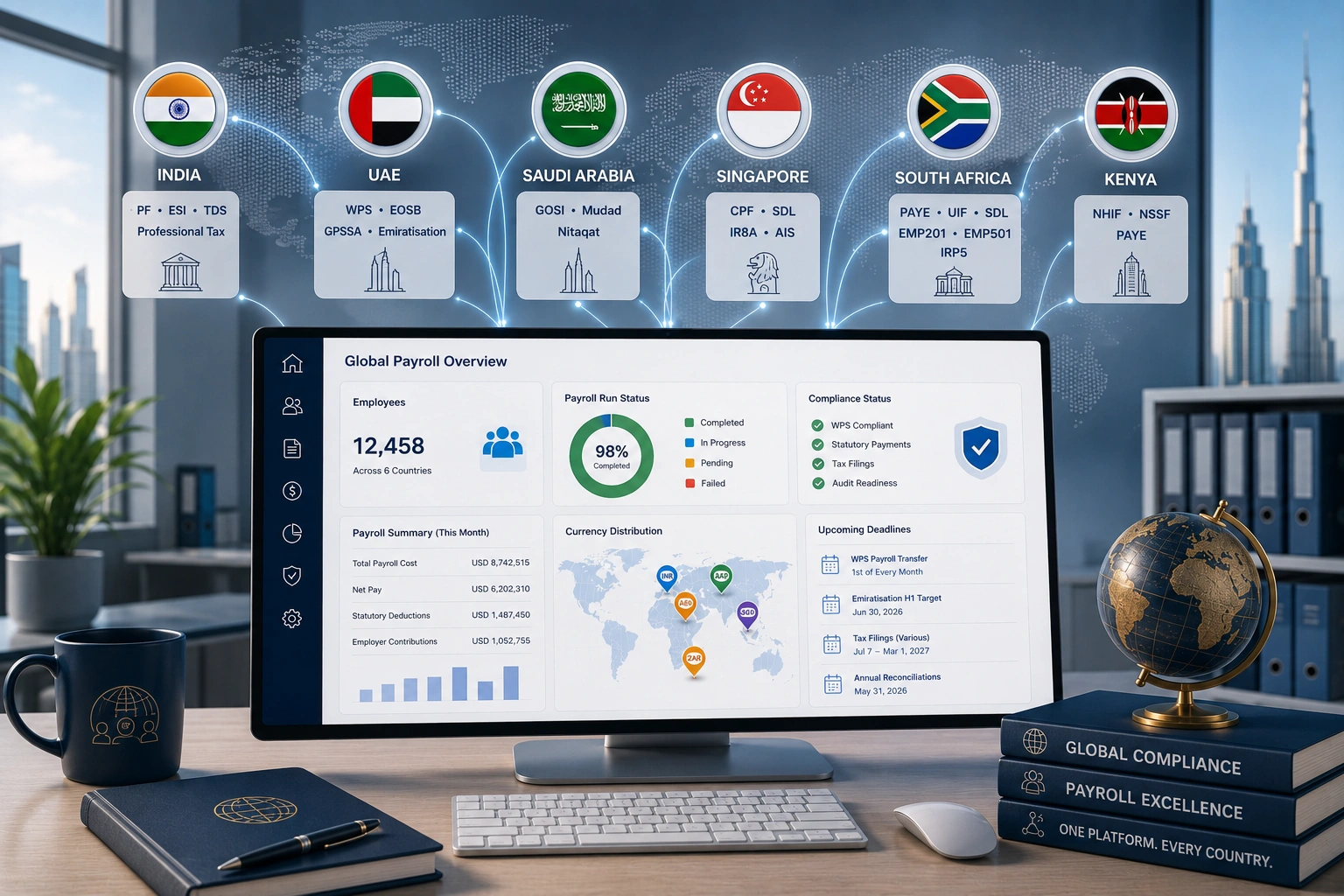


Sars compliance for hr and payroll in South Africa means correctly calculating PAYE, UIF, and SDL from every employee’s earnings, remitting everything to SARS by the 7th of each month, and reconciling it all twice a year through the EMP501. Get any of these wrong and SARS applies automatic penalties – there is no grace period, no exemption for small businesses, and no manual process is accepted anymore. This guide gives you everything you need: the rate tables, the filing deadlines, a worked example, and a monthly compliance checklist.
Official sources: All rates and deadlines in this guide are based on SARS published tax tables and the South African Department of Employment and Labour. Source: SARS – PAYE (sars.gov.za) and Department of Employment and Labour (labour.gov.za)
What Is SARS Compliance for HR and Payroll in South Africa?
SARS (South African Revenue Service) is the national tax authority that administers PAYE, UIF, and SDL – the three statutory payroll obligations every South African employer must meet. Sars compliance for hr means: calculating the correct deductions from every employee’s monthly earnings, remitting them to SARS on time, filing the required returns, and issuing accurate tax certificates to employees.
- Who must register: all employers with at least one employee. Registration must be done with SARS within 21 days of employing a first person. Registering for PAYE automatically triggers UIF and SDL registration.
- Tax year: South Africa’s tax year runs from 1 March to 28/29 February. The current tax year is 2026/2027 (1 March 2026 to 28 February 2027).
- Platform: all submissions must be electronic – via SARS eFiling or e@syFile™ Employer. Manual submissions are no longer accepted for most employers.
PAYE: How Pay-As-You-Earn Works for South African Employers
PAYE is income tax deducted from employees’ earnings each month before they are paid. The employer calculates, withholds, and remits it to SARS. The amount depends on the employee’s annualised taxable income and age.
Tax brackets for the 2025/2026 tax year (1 March 2025 – 28 February 2026), confirmed unchanged for 2026/2027 brackets by SARS. Tax threshold for 2026/2027 (from 1 March 2026) increased to R99,000 for employees under 65:
| Taxable income (annual) | Rate | PAYE calculation |
|---|---|---|
| R1 – R237,100 | 18% | 18% of taxable income |
| R237,101 – R370,500 | 26% | R42,678 + 26% of amount above R237,100 |
| R370,501 – R512,800 | 31% | R77,362 + 31% of amount above R370,500 |
| R512,801 – R673,000 | 36% | R121,475 + 36% of amount above R512,800 |
| R673,001 – R857,900 | 39% | R179,147 + 39% of amount above R673,000 |
| R857,901 – R1,817,000 | 41% | R251,258 + 41% of amount above R857,900 |
| Above R1,817,000 | 45% | R644,489 + 45% of amount above R1,817,000 |
Key deductions that reduce taxable income before PAYE is applied: retirement fund contributions (pension, provident, RA) capped at 27.5% of remuneration up to R350,000/year; medical scheme credits; travel allowances (80% taxable). Fringe benefits and overtime are included in remuneration and increase PAYE.
Worked example: Employee earning R30,000/month gross (R360,000/year), under 65, no additional deductions. Annual PAYE = R74,632 – R17,235 (primary rebate) = R57,397. Monthly PAYE = R4,783. This is the gross tax before any allowable deductions are applied.
UIF and SDL: South Africa’s Other Mandatory Payroll Contributions
Alongside PAYE, every EMP201 declaration must include UIF and (where applicable) SDL. Both are calculated on a fixed rate and declared on the same monthly return.
| Levy | Rate | Who pays | Cap / threshold |
|---|---|---|---|
| PAYE | 18%-45% progressive | Employee (withheld by employer) | Applied on taxable income above R99,000/year (2026/2027) |
| UIF | 1% employee + 1% employer | Both; employer remits both | Earnings ceiling: R17,712/month – max R177.12 per party |
| SDL | 1% of total remuneration | Employer only | Only if total annual payroll exceeds R500,000 |
| COIDA | Varies by industry | Employer only | Annual Return of Earnings to Compensation Commissioner |
UIF provides short-term financial relief to employees who lose income through unemployment, illness, maternity leave, or adoption leave. For uif compliance south africa, employers must also submit a UI-19 return directly to the Department of Employment and Labour (via uFiling at www.labour.gov.za) when employees join or leave – separately from the EMP201.
SDL funds training through SETAs (Sector Education and Training Authorities). Employers above the R500,000 threshold may reclaim up to 20% of SDL paid as mandatory grants for approved training activities.
EMP201 and EMP501: South Africa’s Payroll Filing System Explained
HROPAL’s SARS-compliant payroll module automates EMP201 generation and EMP501 reconciliation, removing the manual data-compilation step that causes most submission errors.
- EMP201 (monthly declaration): the single return that covers PAYE, UIF, SDL, and ETI (Employment Tax Incentive, if applicable). Submitted with payment to SARS by the 7th of each month for the previous month’s payroll. SARS provides a pre-populated Payment Reference Number (PRN) for each submission.
- EMP501 (bi-annual reconciliation): the sars payroll reporting reconciliation that ties together 12 monthly EMP201s, actual payments made to SARS, and employee IRP5/IT3(a) tax certificates. Submitted twice a year: annual submission (1 April – 31 May) and interim submission (1 September – 31 October).
- IRP5 / IT3(a) certificates: issued to every employee after EMP501 submission. IRP5 = employee from whom PAYE was deducted; IT3(a) = employee from whom no PAYE was deducted. These feed directly into employees’ individual tax returns (ITR12).
- ETI (Employment Tax Incentive): a credit against PAYE for employers hiring youth aged 18-29. Claimed monthly on the EMP201 and reconciled on the EMP501. Non-compliant employers forfeit unused ETI.
SARS Payroll Compliance Calendar: Every Deadline You Must Track
| Return | Frequency | Deadline | What it covers |
|---|---|---|---|
| EMP201 | Monthly | 7th of following month (or preceding business day) | PAYE + UIF + SDL + ETI declaration and payment |
| EMP501 Annual | Yearly | 31 May (window opens 1 April) | Full tax year: 1 March – 28/29 February |
| EMP501 Interim | Biannual | 31 October (window opens 1 September) | 6-month period: 1 March – 31 August |
| IRP5 / IT3(a) | Annual | After EMP501 submission | Employee tax certificates for the tax year |
| UI-19 return | As required | On employee joins / leaves; also quarterly | UIF reporting to Department of Employment and Labour |
| COIDA Return of Earnings | Annual | Typically March/April | Compensation Fund; submitted to Compensation Commissioner |
 Penalty for late EMP201: 10% of the outstanding amount plus interest at the prescribed rate, applied automatically. Late EMP501: 1% of annual PAYE liability per month outstanding, up to a maximum of 10%. Wilful or negligent failure to submit is a criminal offence punishable by a fine or up to two years’ imprisonment. Source: SARS PAYE page (sars.gov.za)
Seven Common South Africa Payroll Compliance Mistakes
- Using gross salary as the PAYE base. PAYE is calculated on taxable income – after retirement fund contributions, travel allowance adjustments, and medical tax credits. Using the gross figure overpays tax and causes EMP501 reconciliation errors.
- Excluding fringe benefits from remuneration. Company cars, subsidised loans, and certain employer-paid costs are fringe benefits that must be included in remuneration and taxed accordingly. Omitting them understates PAYE.
- Missing the 7th of the month deadline. The 10% penalty is automatic. There is no appeal for a one-day late submission. Set the payroll close date to the 1st to give three working days’ buffer before the 7th.
- Applying UIF on earnings above the cap. UIF is capped at R17,712/month earnings. For employees earning above this, UIF is fixed at R177.12/month per party – not calculated on their full salary.
- Not reconciling EMP201 totals with EMP501. sars payroll reporting requires the EMP501 to match the sum of the year’s EMP201s and actual payments. Discrepancies trigger an audit query.
- Incorrect IRP5 certificates. Errors on IRP5 certificates create problems for employees’ personal tax returns and result in SARS contacting both the employer and employee for corrections.
- Late SARS registration. Registration must happen within 21 days of employing a first person. Late registration means backdated liability for all PAYE, UIF, and SDL from the first payroll date, plus penalties on the arrears.
Monthly SARS Payroll Compliance Checklist
For sars compliant payroll, run through this before the 7th of every month and before each EMP501 window. HROPAL’s payroll compliance module automates the EMP201 calculation and generates the reconciliation data for EMP501 submissions.
Monthly (before the 7th):
- Calculate PAYE for each employee using the correct taxable income (after retirement, medical, and travel allowance adjustments).
- Calculate UIF at 1% per party, capped at R177.12 each for employees earning above R17,712/month.
- Calculate SDL at 1% of total remuneration if annual payroll exceeds R500,000.
- Apply ETI credits if eligible employees are on the payroll (ages 18-29, meeting SARS criteria).
- Submit EMP201 via SARS eFiling with payment by the 7th of the month using the pre-populated PRN.
- Submit UI-19 returns to the Department of Employment and Labour for any employee starts or exits this month.
Annual / biannual:
- Complete EMP501 annual reconciliation by 31 May – confirm that all 12 EMP201s, payments, and IRP5 certificate totals agree.
- Complete EMP501 interim reconciliation by 31 October for the 1 March – 31 August period.
- Issue IRP5 and IT3(a) certificates to all employees promptly after each EMP501 submission.
- File COIDA Return of Earnings with the Compensation Commissioner (typically March/April).
- Keep all payroll records, EMP201 submissions, and payment confirmations for a minimum of 5 years.
Frequently Asked Questions About SARS Payroll Compliance in South Africa
Q1. What is SARS compliance for HR in South Africa?
SARS compliance for HR means correctly calculating PAYE, UIF, and SDL deductions from every employee’s monthly earnings, remitting them to the South African Revenue Service by the 7th of each month via the EMP201, and filing bi-annual EMP501 reconciliations. It also includes issuing IRP5 tax certificates to employees and maintaining payroll records for five years.
Q2. What is the PAYE rate in South Africa for 2026?
PAYE in South Africa follows a progressive rate structure with seven brackets ranging from 18% on the first R237,100 of annual taxable income to 45% above R1,817,000. For the 2026/2027 tax year (from 1 March 2026), employees under 65 only pay PAYE on annual income above R99,000. The employer withholds and remits the calculated amount monthly.
Q3. What is the UIF contribution rate in South Africa?
UIF is 1% of remuneration deducted from the employee and a matching 1% from the employer – 2% total. Contributions are capped at earnings of R17,712 per month, so the maximum monthly UIF is R177.12 from the employee and R177.12 from the employer. For uif compliance south africa, employers also submit UI-19 returns to the Department of Employment and Labour.
Q4. What is the deadline for EMP201 submission in South Africa?
The EMP201 is due by the 7th of the month following the payroll period, or the preceding business day if the 7th falls on a weekend or public holiday. Late submission triggers an automatic 10% penalty on the outstanding amount plus interest – there is no grace period and no manual exception process.
Q5. What is the EMP501 and when is it due?
The EMP501 is the bi-annual SARS payroll reporting reconciliation that ties together the year’s EMP201 declarations, actual SARS payments, and employee IRP5 or IT3(a) tax certificates. It is submitted twice yearly: annual reconciliation by 31 May, and interim reconciliation by 31 October. Late submission carries a penalty of 1% of annual PAYE liability per month, up to 10%.
Q6. How does HRMS software help with south africa payroll compliance?
A SARS-compliant payroll system calculates PAYE on taxable income (not gross salary), applies UIF caps, generates the EMP201 declaration data each month, and builds the EMP501 reconciliation automatically from the year’s payroll runs. It also produces IRP5 certificates and maintains the audit trail SARS expects to find on inspection.