
Two changes took effect on 1 January 2026 that every Singapore payroll team must have applied from the first pay run of the year: the CPF Ordinary Wage ceiling increased from S$7,400 to S$8,000 per month, and CPF contribution rates for employees aged above 55 to 65 increased as part of Singapore’s senior worker retirement roadmap. This guide gives you the verified singapore cpf rates 2026, the MOM payslip and reporting requirements, the IRAS IR8A and AIS obligations, and a monthly compliance checklist for HR and finance teams.
📌 Official sources used: CPF Board (cpf.gov.sg) | Ministry of Manpower (mom.gov.sg) | IRAS (iras.gov.sg)
What Is CPF and How Does It Work for Singapore Employers?
The Central Provident Fund (CPF) is Singapore’s mandatory social security savings scheme. Employers deduct the employee’s share from their monthly wages and add the employer’s share on top, remitting both to the CPF Board by the last day of each month. CPF funds three accounts:
- Ordinary Account (OA): housing, insurance, education, and approved investments.
- Special Account (SA): retirement savings and approved retirement investments.
- MediSave Account (MA): medical expenses and approved insurance premiums.
CPF applies to Singapore Citizens and Permanent Residents only. Foreign employees on Employment Pass, S Pass, or Work Permit are not subject to CPF, though they are subject to SDL and (for S Pass/WP holders) the Foreign Worker Levy.
Singapore CPF Rates 2026: Updated Contribution Table by Age
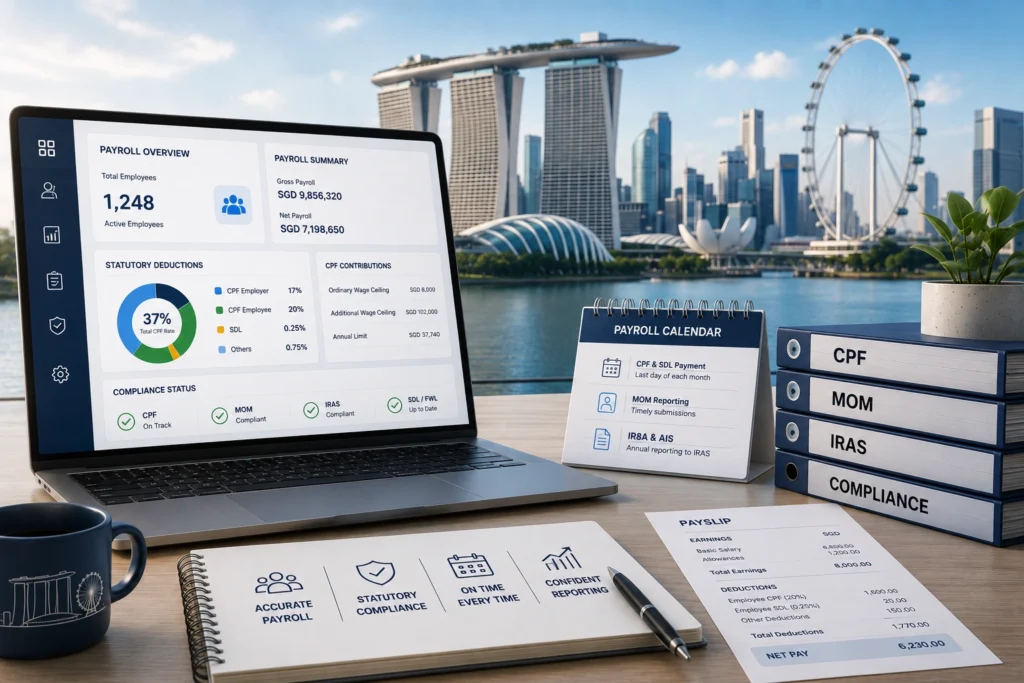
The following rates apply from 1 January 2026 for Singapore Citizens and SPRs from the third year of residency onwards, earning more than S$750 per month. The OW ceiling of S$8,000/month applies to all age groups:
| Employee age | Employer rate | Employee rate | Total rate | vs 2025 |
|---|---|---|---|---|
| 55 and below | 17% | 20% | 37% | Unchanged |
| Above 55 to 60 | 16% | 18% | 34% | +4% (from 30%) |
| Above 60 to 65 | 12.5% | 12.5% | 25% | +4% (from 21%) |
| Above 65 to 70 | 10.5% | 6% | 16.5% | +1.5% (from 15%) |
| Above 70 | 8.5% | 4% | 12.5% | +1.5% (from 11%) |
📌 2026 change: The OW ceiling rose from S$7,400 to S$8,000/month – the final step of a four-stage increase begun in September 2023. For employees earning above S$8,000/month, only the first S$8,000 is subject to CPF on the ordinary wage side. Verify rates for your exact age brackets at cpf.gov.sg
Note on age transitions: the rate change does not apply on an employee’s birthday. It takes effect from the first day of the month after the employee turns 55, 60, 65, or 70. Payroll must be updated at the correct month boundary, not mid-month.
CPF Contribution Rates Singapore: Ceilings, Worked Examples, and SPR Rules
Two ceilings determine how much of an employee’s pay attracts CPF contributions:
- Ordinary Wage (OW) ceiling: S$8,000/month from 1 January 2026. Regular monthly salary above S$8,000 does not attract CPF on the OW portion.
- Additional Wage (AW) ceiling: S$102,000 minus the total OW subject to CPF paid during the year. Covers bonuses and other irregular payments.
- CPF Annual Limit: S$37,740. The maximum employee CPF contribution in a calendar year.
📌 Worked example A (age 45, salary S$9,000/month): OW ceiling applies. Employer CPF: 17% x S$8,000 = S$1,360. Employee CPF: 20% x S$8,000 = S$1,600. Total monthly CPF: S$2,960. The S$1,000 above the ceiling does not attract CPF.
📌 Worked example B (age 58, salary S$6,000/month): Full S$6,000 is below the ceiling. Employer CPF: 16% x S$6,000 = S$960. Employee CPF: 18% x S$6,000 = S$1,080. Total monthly CPF: S$2,040.
First and second-year Permanent Residents pay at graduated lower rates, which increase progressively until they reach full citizen rates in their third year of PR status.
SDL, Foreign Worker Levy, and Other Singapore Payroll Levies
- Skills Development Levy (SDL): 0.25% of monthly wages per employee, minimum S$2, maximum S$11.25. Payable on ALL employees – citizens, PRs, and foreign workers. Collected together with CPF contributions.
- Foreign Worker Levy (FWL): monthly levy payable for each S Pass and Work Permit holder. Rates vary by industry (manufacturing, construction, services) and dependency ratio tier. Employment Pass holders are exempt.
- Mandatory medical insurance: employers must provide at least S$15,000 of inpatient and day-surgery coverage for S Pass and Work Permit holders.
- Employment Pass minimum salary (2026): S$5,600/month for most sectors; S$6,200/month for financial services. Payroll records must match the EP-declared fixed monthly salary used in MOM’s pass applications.
IRAS Payroll Obligations: IR8A, Auto-Inclusion Scheme, and Tax Clearance
Singapore does not require employers to withhold monthly income tax from employee salaries (unlike Pay-As-You-Earn systems in India, UAE, or South Africa). Instead, employees file their own annual income tax returns. However, employers carry significant annual reporting obligations to IRAS:
- Form IR8A: the annual employment income declaration for every employee. iras payroll reporting requires employers to submit IR8A data covering all income, allowances, and benefits paid during the calendar year.
- Auto-Inclusion Scheme (AIS): mandatory for employers with 5 or more employees. Under AIS, the employer submits data directly to IRAS electronically via myTax Portal. The data flows automatically into each employee’s personal tax return. Employers under AIS do not issue paper IR8A forms to employees.
- Deadline: 1 March each year for the preceding calendar year’s income. Late submission is a criminal offence, with fines up to S$1,000 per employee or imprisonment.
- Appendix 8A: required for any employee who received non-cash benefits during the year (company housing, vehicle, club membership, school fees, medical insurance above certain limits).
- Appendix 8B: required for employees with stock options (ESOP) or share awards (RSU) that vested or were exercised during the year.
- Form IR21 (tax clearance): required for all non-Singaporean, non-PR employees who are leaving Singapore or ceasing employment. Must be filed with IRAS at least one month before the employee’s last day. The employer must withhold all remaining salary until IRAS issues clearance.
MOM Payroll Compliance: Payslips, Payment Deadlines and Record Retention
The Ministry of Manpower enforces payroll compliance outside of CPF and tax reporting. Key MOM obligations:
- Itemized payslips: mandatory for all employees under the Employment Act. Must be issued within 3 working days before or after salary payment. Payslip must include: employer name and CPF Submission Number, employee name and identification number, salary period, basic salary, allowances, overtime hours and pay, deductions (CPF, levies), and net pay.
- Salary payment frequency: salaries must be paid within 7 days after the end of each salary period. Overtime must be paid within 14 days after the period in which it was worked.
- CPF payment deadline: contributions must reach the CPF Board by the last day of the calendar month. Enforcement triggers if payment is not received by the 14th of the following month. Late payment interest is 1.5% per month on the outstanding amount.
- Record retention: payslips and employment records must be kept for 2 years for current employees, and 1 year after departure for ex-employees. CPF contribution records must be retained for 5 years.
Singapore Payroll Compliance Checklist: Monthly and Annual Tasks
Run this before every monthly payroll close and at the start of each annual reporting window. HROPAL’s Singapore payroll module automates CPF calculation, SDL, and the annual IR8A data export.
Monthly (by the 14th of the following month):
- Calculate CPF at correct 2026 rates for each employee’s age band, capped at the S$8,000 OW ceiling.
- Calculate SDL at 0.25% of monthly wages for every employee (citizens, PRs, and foreigners), minimum S$2.
- Submit CPF and SDL via CPF EZPay, GIRO, or PayNow to the CPF Board.
- Pay Foreign Worker Levy for all S Pass and Work Permit holders.
- Issue itemized payslips within 3 working days of salary payment.
- For employees with birthday age-band transitions, update the rate from the first day of the following month.
Annual (by 1 March):
- Submit IR8A data via AIS on myTax Portal (mandatory for 5+ employees); issue paper/digital IR8A for smaller employers.
- File Appendix 8A for any employee who received non-cash benefits during the year.
- File Appendix 8B for any employee with ESOP or RSU events during the year.
- Verify year-to-date OW and AW totals against the annual CPF limit (S$102,000) before processing December bonuses.
On foreign employee departure:
- File Form IR21 with IRAS at least one month before the employee’s last working day.
- Withhold final salary payment until IRAS issues tax clearance.
For multi-country HR teams, see HROPAL’s guide on HR compliance strategies for global workforces, and how accruals and benefits management handles CPF and gratuity accruals across APAC and MENA entities.
Frequently Asked Questions
Q1. What are the Singapore CPF rates for 2026?
From 1 January 2026, CPF contribution rates for Singapore Citizens and PRs earning above S$750/month are: 37% total (17% employer + 20% employee) for age 55 and below; 34% (16% + 18%) for above 55 to 60; 25% (12.5% + 12.5%) for above 60 to 65; 16.5% for above 65 to 70; and 12.5% for above 70. The Ordinary Wage ceiling increased to S$8,000/month.
Q2. What changed in Singapore CPF rates in January 2026?
Two changes took effect on 1 January 2026: the CPF Ordinary Wage ceiling increased from S$7,400 to S$8,000 per month (the final step of a phased increase begun in September 2023), and CPF contribution rates for employees aged above 55 to 65 increased by approximately 1.5 to 4 percentage points depending on age band, to strengthen senior workers’ retirement savings.
Q3. Who must pay CPF in Singapore?
CPF contributions apply to Singapore Citizens and Permanent Residents working in Singapore. Foreign employees on Employment Pass, S Pass, or Work Permit are not subject to CPF. However, SDL (Skills Development Levy) applies to all employees including foreign workers, and employers must pay the Foreign Worker Levy for S Pass and Work Permit holders.
Q4. What is the IRAS IR8A deadline for employers?
Employers must submit Form IR8A (or file via the Auto-Inclusion Scheme on myTax Portal) by 1 March each year for the preceding year’s employment income. AIS is mandatory for employers with 5 or more employees. Late submission is a criminal offence carrying fines up to S$1,000 per employee or imprisonment.
Q5. When must Singapore employers pay CPF contributions?
CPF contributions must reach the CPF Board by the last day of the calendar month. Enforcement triggers if payment is not received by the 14th of the following month, with late payment interest charged at 1.5% per month on the outstanding amount. Employers should submit by the last working day of the month to ensure timely clearance.
Q6. What are Singapore’s MOM payslip requirements in 2026?
The Employment Act requires employers to issue itemized payslips to all employees within 3 working days before or after salary payment. Payslips must include employer name and CPF Submission Number, employee identification, salary period, basic salary, allowances, overtime hours and pay, deductions, and net salary. Payslip records must be retained for at least 2 years.