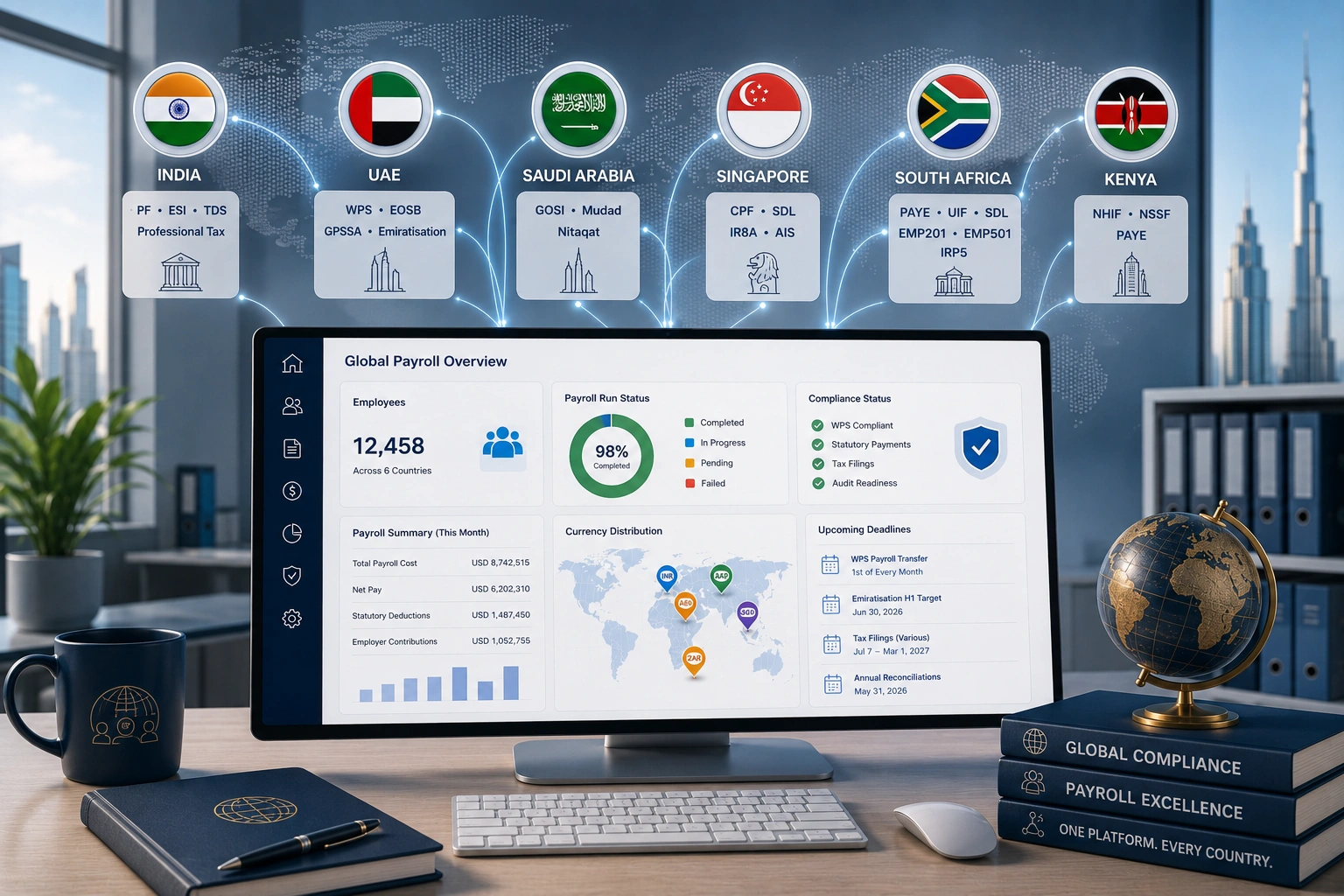


Saudi payroll compliance in 2026 is more complex than at any point in the past decade: gosi saudi arabia now operates under two parallel contribution systems following the July 2024 law reform, the Nitaqat Mutawar phase that launched in April 2026 eliminated the Yellow band and raised sector quotas across the board, and Mudad WPS cross-references salary data against employment contracts and GOSI records in real time. This guide gives HR and finance teams the verified 2026 rates, the Mudad submission process, the Nitaqat consequences, and a monthly compliance checklist
📌 Official sources: GOSI (gosi.gov.sa) | MHRSD (hrsd.gov.sa) | Verify rates before configuring payroll – GOSI System B increases by 0.5% each July through 2028.
Saudi Arabia Payroll: The Regulatory Framework at a Glance
Three compliance systems run in parallel for every Saudi private-sector employer. All three are monitored by the Ministry of Human Resources and Social Development (MHRSD) and share real-time data:
- GOSI (General Organisation for Social Insurance): monthly social insurance contributions for Saudi nationals (pension, occupational hazards, unemployment) and occupational hazard contributions for expatriates.
- Mudad WPS (Wage Protection System): mandatory electronic salary payment system. All wages must pass through a SAMA-approved bank, with a Salary Information File submitted to the Mudad platform by the 10th of each month.
- Nitaqat / Qiwa (Saudization): mandatory Saudi national workforce percentage requirements, tracked through the Qiwa platform and enforced through visa and Iqama restrictions.
The critical compliance risk in 2026 is that all three systems cross-reference each other automatically. Mudad checks that the salary transferred matches the Qiwa contract salary and the GOSI-reported wage. A mismatch between any two of the three triggers an automatic flag – no employee complaint is required.
For multi-country employers running Saudi payroll alongside India, UAE, or Africa entities, HROPAL’s multi-region payroll module handles GOSI, Mudad WPS, and Nitaqat tracking alongside PF, WPS UAE, CPF, and SARS in a single platform.
GOSI Saudi Arabia 2026: Rates, Calculation Base, and the Two-System Split
The July 2024 New Social Insurance Law created two parallel GOSI systems. Which system applies depends on when the employee was first registered with GOSI – a single payroll table can no longer serve the whole workforce.
| Employee type | Annuities (pension) | Occ. hazards | SANED (unemployment) | Total ER / EE |
|---|---|---|---|---|
| Saudi national – System A (hired before July 3, 2024) | 9% ER + 9% EE | 2% ER only | 0.75% ER + 0.75% EE | 11.75% ER / 9.75% EE |
| Saudi national – System B (hired on/after July 3, 2024): from July 2026 | 10% ER + 10% EE | 2% ER only | 0.75% ER + 0.75% EE | 12.75% ER / 10.75% EE |
| Expatriate employee (any hire date) | Not applicable | 2% ER only | Not applicable | 2% ER / 0% EE |
📌 2026 change – System B rates: From July 1, 2026, System B Saudi employees (hired on/after July 3, 2024) moved from 22.5% combined to 23.5% combined (employer 12.75% + employee 10.75%). The annuity component increases by 0.5% per side each July until reaching 11%+11% in July 2028. Any payroll applying a single flat rate to all Saudi national employees has been producing incorrect deductions since July 2025.
Contribution base: saudi gosi contributions are calculated on basic salary plus housing allowance – not gross salary. This is a key difference from UAE, where EOSB uses basic salary only.
Monthly ceiling: SAR 45,000/month. GOSI is not calculated on any amount above this cap, regardless of actual salary.
GOSI deadline: contributions must reach GOSI by the end of each calendar month. Late payment penalty: 2% per month on outstanding amounts plus a SAR 10,000 fine per employee registered late.
GCC nationals: GCC national employees (Bahrain, Kuwait, Oman, Qatar, UAE) are covered under their home country pension arrangements and generally contribute at Saudi GOSI rates equivalent to System A.
Mudad WPS Saudi Arabia 2026: How the Wage Protection System Works
Mudad is Saudi Arabia’s WPS platform, operated by MHRSD. Unlike UAE WPS, which uses a pipe-delimited SIF file submitted through banks, Saudi Mudad uses an XML wage file submitted directly to the Mudad portal, with real-time reconciliation against Qiwa employment contracts and GOSI salary records.
2026 update: From January 1, 2026, the Mudad WPS mandate was extended to domestic workers. Employers with even one domestic staff member (drivers, housekeepers, cooks) must now process their wages through the Musaned platform, which feeds into Mudad.
The monthly Mudad WPS cycle for private-sector employers:
- Register on Mudad. Link your commercial registration to the Mudad platform (mudad.com.sa) and connect to your Qiwa account. Every employee must be enrolled on Mudad with their Saudi ID or Iqama number.
- Run payroll and generate the wage file. The mudad wps saudi XML file contains each employee’s ID, contracted salary, housing allowance, basic salary, deductions, and net pay. The amounts must match the Qiwa contract and GOSI-reported salary exactly.
- Submit the wage file to Mudad. Upload the XML file at least one business day before the salary payment date.
- Transfer salaries through a SAMA-approved bank. All major Saudi banks are approved. Salaries must reach employees by the 10th of the following month for most employers.
- Mudad confirms compliance. MHRSD receives the payment confirmation. The system cross-checks the transferred amount against the Qiwa contract and GOSI records. Mismatches are flagged automatically.
| Violation | Penalty | Additional consequence |
|---|---|---|
| Late salary payment (after 10th) | SAR 3,000 per employee per month | Automatic Nitaqat band downgrade risk; recorded in MHRSD compliance score |
| Wage file not uploaded or uploaded late | SAR 5,000-50,000 (scale varies by violation severity) | Work permit issuance and Iqama renewal suspended |
| Salary amount does not match Qiwa contract | Flag for MHRSD inspection | Employee can initiate a labour dispute without giving prior notice |
| Repeated violations | Business closure order possible | Loss of Nitaqat Green status; General Manager Iqama renewal blocked |
Nitaqat and Saudization 2026: The New Mutawar Phase and What Changed
⚠ Critical 2026 change: The Nitaqat Mutawar (Developed Nitaqat) three-year phase took effect April 26, 2026. The Yellow band has been permanently eliminated. Companies previously in Yellow automatically moved to Red. Band thresholds and sector C-values have increased across most economic activities.
Nitaqat classifies every Saudi private-sector employer by the percentage of Saudi nationals in their workforce relative to the sector-specific target. The classification determines access to government services and expatriate hiring rights:
| Nitaqat band | Employer status | Key consequence |
|---|---|---|
| Platinum | Significantly above required Saudization rate | Priority government services; preferred Qiwa access |
| High Green | Above required Saudization rate | Full work visa and Iqama services; preferred employer status |
| Medium Green | At the required Saudization rate | Full services; standard compliance |
| Low Green | Marginally above the minimum | Full services; monitoring; at risk from C-value increases |
| Red (was Yellow + below) | Below required Saudization rate | No new work visas; no Iqama renewals; expat employees can transfer sponsorship out; GM Iqama renewal blocked |
Selected 2026 profession-specific Saudization quotas (illustrative; verify your sector’s exact C-value through the MHRSD Nitaqat portal):
| Sector / profession | Required Saudization | 2026 notes |
|---|---|---|
| Marketing / Sales | 60% | Effective April 19, 2026; raised from prior level |
| Procurement | 70% | Effective from June 2026 after grace period |
| Engineering (46 roles) | 30% | Effective from July 2026 after grace period |
| Healthcare – Hospitals | 65% | Effective July 2026 |
| Retail | 40% | |
| Telecommunications | 70% | |
| Tourism | 40% |
- Qiwa contract documentation (from April 15, 2026): A Saudi employee’s Qiwa-documented employment contract must exist for them to count toward the Saudization percentage. Employees without a Qiwa-registered contract do not count toward Nitaqat, regardless of whether they are on the GOSI register.
- The C-value risk: the nitaqat saudization 2026 Mutawar formula raises required percentages each year through 2028. A company that stays Green this year can slip to Red next year without changing its Saudi headcount – the target has moved. Payroll and HR systems must track the current C-value for the employer’s specific GOSI economic activity code.
- Who counts as Saudi: Saudi nationals with Qiwa contracts; GCC nationals (counted as Saudi for Nitaqat); employees with disabilities (count as 4 persons); part-time workers with 160+ hours/month (count as 1 full person).
Saudi End of Service Benefit: How Gratuity Differs From UAE
Saudi EOSB is governed by Article 84 of the Saudi Labour Law and differs structurally from UAE in one critical way: the amount depends on why the contract ended. HROPAL’s accruals and benefits module calculates both Saudi and UAE EOSB correctly in the same platform.
| Termination reason | Entitlement | Notes |
|---|---|---|
| Employer terminates (any duration) | Full EOSB from day 1 at 0.5 months/year (first 5 years) then 1 month/year | Same formula as UAE; applies from first year |
| Employee resigns – under 2 years | No EOSB | Zero entitlement; main difference from UAE |
| Employee resigns – 2 to 5 years | 1/3 of full EOSB | Graduated scale; discourages early resignation |
| Employee resigns – 5 to 10 years | 2/3 of full EOSB | |
| Employee resigns – 10 years or more | Full EOSB | Same as termination entitlement |
Calculation base: Saudi EOSB is calculated on the employee’s last basic wage. The Saudi Labour Law defines ‘wage’ broadly to include regular allowances in some interpretations; obtain legal advice on the specific components to include for your establishment.
Medical insurance: all employers in Saudi Arabia must provide health insurance for all employees and their dependents, as mandated by the Council of Cooperative Health Insurance (CCHI). This is a separate compliance obligation from GOSI, Mudad WPS, and Nitaqat.
Saudi Payroll Compliance Checklist: Monthly, Quarterly, and Annual Tasks
Run this before every payroll cycle and at each Nitaqat review window. See HROPAL’s guide on HR compliance for global workforces and the multi-country payroll compliance MENA guide for the broader multi-region context.
Monthly:
- GOSI calculation: apply System A rates to pre-July 2024 Saudi hires, System B rates (updated each July) to post-July 2024 hires, and 2% employer-only to expatriates. Cap contribution base at SAR 45,000.
- Mudad wage file: generate the XML SIF matching Qiwa contract salaries exactly. Submit to Mudad at least one business day before salary transfer.
- Salary transfer: ensure all employees receive wages by the 10th of the month through a SAMA-approved bank.
- Salary-Qiwa-GOSI reconciliation: verify that the transferred amount, the Qiwa contract salary, and the GOSI-reported wage all agree. Discrepancies trigger automatic enforcement.
Quarterly:
- Nitaqat band check: log into the Qiwa portal and verify current band classification. Check whether any Saudi employees lack Qiwa-documented contracts (they do not count toward Nitaqat if undocumented).
- Profession-specific quota check: verify compliance in any profession with a specific Saudization quota (marketing, procurement, engineering, healthcare) – a company can pass the headline band and fail on a single profession.
- Iqama and visa expiry review: track expiry dates for all expatriate employees 90 days in advance. Red-band classification blocks renewals entirely.
Annual:
- EOSB accrual review: calculate end-of-service benefit accruals for all employees approaching contract milestones. Update financial provisions, especially for any employees reaching the 5-year and 10-year thresholds.
- Medical insurance renewal: confirm all employees and their eligible dependents have active CCHI-compliant health coverage with no lapse between policy periods.
- GOSI System B rate update (each July): update payroll system configuration to reflect the new System B annuity rates before the July payroll run.
- Nitaqat C-value update (April each year): check MHRSD for updated sector C-values for the new Nitaqat year. Under the 2026-2028 plan, a company’s Nitaqat classification can change even if its saudi payroll compliance headcount ratios are unchanged.
Frequently Asked Questions
Q1. What are the GOSI contribution rates in Saudi Arabia in 2026?
In 2026, Saudi Arabia operates two GOSI systems. For Saudi nationals hired before July 3, 2024 (System A), the combined rate is 21.5%: employer 11.75% (9% annuity + 2% occupational hazards + 0.75% SANED) and employee 9.75% (9% annuity + 0.75% SANED). For Saudi nationals hired on or after July 3, 2024 (System B), from July 2026 the combined rate is 23.5%: employer 12.75% and employee 10.75%. Expatriate employees: employer pays 2% for occupational hazards only; employees pay nothing.
Q2. What is the GOSI contribution base in Saudi Arabia?
GOSI contributions in Saudi Arabia are calculated on basic salary plus housing allowance, capped at SAR 45,000 per month. This differs from UAE, where end-of-service gratuity is calculated on basic salary only. Any amount above the SAR 45,000 ceiling is excluded from GOSI calculations, regardless of the employee’s total compensation.
Q3. What is Mudad WPS and what is the salary payment deadline?
Mudad is Saudi Arabia’s Wage Protection System, operated by MHRSD. All private sector employers must submit an XML salary file to the Mudad portal and transfer wages through a SAMA-approved bank. Salaries must reach employees by the 10th of each month for most employers. From January 1, 2026, the Mudad WPS mandate was extended to cover domestic workers as well.
Q4. What is the Nitaqat Mutawar phase that started in April 2026?
The Nitaqat Mutawar (Developed Nitaqat) is a three-year Saudization reform that took effect April 26, 2026 and runs through 2028. The key changes are: the Yellow classification band was eliminated (companies previously in Yellow automatically became Red); C-values (which determine required Saudization percentages by sector) were raised across most economic activities; and profession-specific quotas were applied to 269 roles. A company’s Nitaqat band can fall even if its Saudi headcount stays the same, because the target threshold has moved.
Q5. How does Saudi EOSB differ from UAE gratuity?
Saudi and UAE end-of-service calculations use the same basic formula (0.5 months per year for the first 5 years, 1 month per year thereafter) but differ critically in resignation treatment. Under Saudi Labour Law, employees who resign before completing 2 years receive no gratuity; those who resign after 2-5 years receive one-third; after 5-10 years, two-thirds; and only after 10 years does a resigning employee receive the full amount. In UAE, the same full formula applies regardless of resignation vs termination.
Q6. What happens if a company falls into the Nitaqat Red band?
A Red-band company cannot issue new work visas, cannot transfer expatriate employees in, and cannot renew existing Iqamas. Expatriate employees of a Red-band company have the legal right to transfer their sponsorship to another employer without the company’s consent. In addition, the General Manager’s own Iqama renewal is blocked, the company is excluded from government tenders on the Etimad platform, and access to most MHRSD digital services is suspended until compliance is restored.