

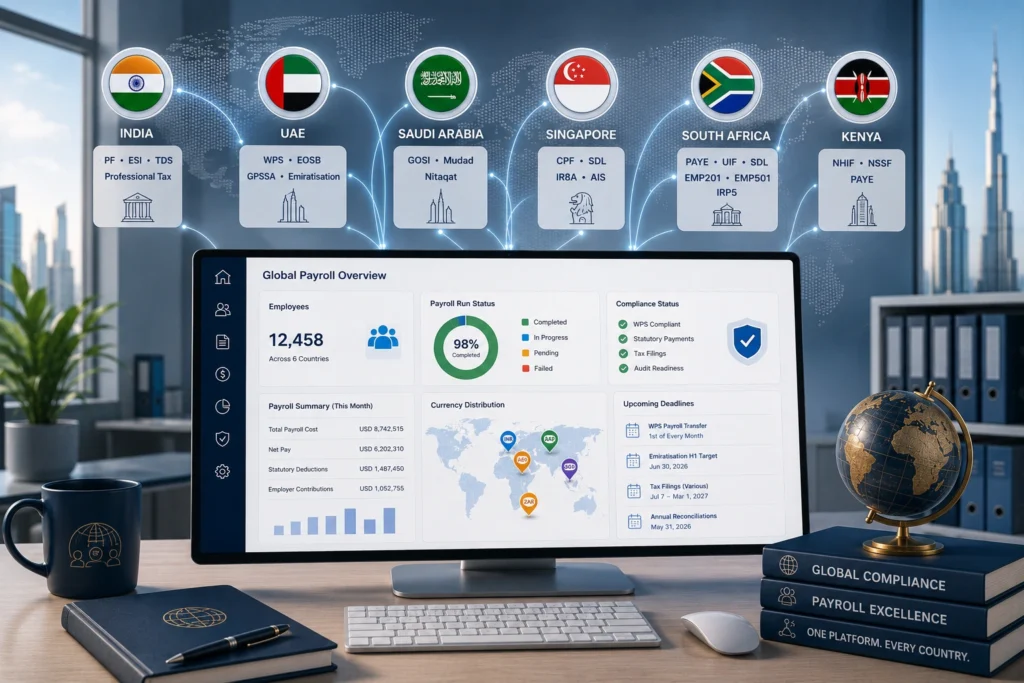
Multi country payroll is not a single process run across multiple currencies. It is six or seven fundamentally different statutory frameworks — different wage definitions, different filing authorities, different deadlines, different penalties — running simultaneously. Every country has its own compliance logic, and a platform that handles one correctly is not inherently capable of handling four. This guide explains what makes each region complex, why single-country tools fail, and what to look for in an HCM platform.
TL;DR
- Multi country payroll requires separate statutory compliance engines for each country, not a single process adapted for multiple currencies.
- India (PF/ESI/TDS), UAE (WPS/EOSB), Saudi Arabia (GOSI/Nitaqat), Singapore (CPF/SDL/IR8A), and South Africa (PAYE/UIF/SDL/EMP201) each run on fundamentally different payroll frameworks.
- India-only platforms such as Keka, greytHR, and Darwinbox cannot run UAE WPS, Saudi GOSI, Singapore CPF, or South Africa PAYE without bolting on a separate system per country.
- The biggest risk for a CFO isn’t picking the wrong contribution rate today — it’s relying on a platform that can’t auto-update those rates the moment regulations change.
- Below are eight questions every CFO should ask an HCM vendor before signing a multi-region payroll contract.
Why Multi-Country Payroll Isn’t “Same Process, Different Country”
Most failed multi-region payroll rollouts start with the same flawed assumption: that payroll works the same way everywhere and the differences are just configuration. That assumption breaks down as soon as you compare two countries side by side.
In India, Provident Fund is calculated on “basic wages” as defined under the EPF Act — not gross salary or CTC — with a 12% contribution from both employer and employee. Miss a payment and you’re looking at 12% annual interest plus damages of up to 100% of the arrears under Section 14B.
In the UAE, the core employer obligation is the Wage Protection System (WPS) transfer: a mandatory electronic salary payment through an approved bank, submitted in a specific SIF file format by the 1st of each month. There’s no income tax, but end-of-service benefits (EOSB) accrue at 21 days of basic salary per year for an employee’s first five years.
These aren’t variations on a theme. They’re entirely different compliance frameworks, with different wage bases, different authorities, different filing formats, and different penalties — and a platform built to handle one correctly doesn’t automatically handle the other.
A multi-region payroll platform isn’t a single payroll engine with a tax-table swap. It’s a set of country-specific compliance modules, each maintained by a team with local statutory expertise, wrapped in a single data model and reporting layer. Source: Gartner – Global Payroll Technology.
Country-by-Country Compliance Matrix: What Each Region Requires
The table below summarizes the core payroll compliance obligations for five key markets.
| Country | Key statutory system | Core employer obligations | Highest-penalty risk |
|---|---|---|---|
| India | PF, ESI, TDS, Professional Tax | PF (12% + 12% on basic wages), ESI for eligible employees, TDS, state-level Professional Tax | Retrospective EPFO audits and Section 14B damages for incorrect wage-base calculations |
| UAE | WPS, EOSB, GPSSA, Emiratisation | Monthly WPS SIF salary transfer, EOSB accrual, GPSSA for UAE nationals, Emiratisation quota tracking | Missing WPS triggers an automatic MOHRE flag and work permit suspension; Emiratisation fines apply per unfilled position |
| Saudi Arabia | GOSI, Nitaqat | GOSI contributions (11.75% employer + 9.75% employee) via Mudad, Nitaqat Saudization quota tracking | Nitaqat non-compliance restricts the ability to renew or issue new work permits |
| Singapore | CPF, SDL, IR8A/IR21 | Age-banded CPF contributions, SDL, annual IR8A filing via AIS, IR21 for departing foreign employees | Late CPF interest and criminal fines for late IR8A filing |
| South Africa | PAYE, UIF, SDL, EMP201/EMP501 | Progressive PAYE, capped UIF, SDL, monthly EMP201 filing, annual EMP501 reconciliation, IRP5 certificates | Automatic penalty for late EMP201; ongoing monthly interest on late EMP501 |
Every row in this table has a different wage definition, a different filing authority, and different penalty triggers. No single configuration handles all of them — each requires a purpose-built compliance module.
Why India-Only HR Platforms Can’t Handle Multi-Region Payroll
India’s HR software market is large and genuinely well-served — platforms like Keka, greytHR, and Darwinbox are strong for India compliance. But their architecture is built around a single country, and the gap to multi-region compliance is structural, not something configuration can close:
- No WPS SIF integration. UAE WPS requires a specific file submitted to a MOHRE-approved bank with the employer’s Establishment ID and each employee’s Labour Card number and IBAN — not a generic payroll export.
- No GOSI or Nitaqat engine. Saudi GOSI contributions and Nitaqat Saudization tracking run on calculation logic and filing channels that don’t exist in India-native products.
- No Singapore CPF module. CPF rates change annually by age band — January 2026 raised the Ordinary Wage ceiling to S$8,000 — and an India-built platform has no mechanism to pick up or apply those changes.
- No multi-currency payroll or payslips. Running payroll in INR and AED simultaneously, with a consistent exchange-rate treatment for group reporting, isn’t a feature single-country tools offer.
- No cross-region compliance update SLA. When Singapore changed CPF rates or the UAE’s Resolution 340 took effect, a genuine multi-region platform updated automatically. A company juggling one tool for India and a spreadsheet for UAE is a common root cause of retroactive WPS violations.
The CFO’s Consolidation Problem: Integrating Multi-Region Payroll Data
Even when each country’s payroll runs correctly in its own tool, CFOs are left without a consolidated view. The integration challenges fall into three buckets:
- Multi-currency consolidation. A company running payroll in INR, AED, SGD, ZAR, and KES needs total people cost in one functional currency, with an exchange-rate treatment consistent with accounting policy — instead of manually reconciling exports from multiple systems every month-end.
- Fiscal year misalignment. India’s financial year runs April–March, the UAE and Singapore follow the calendar year, and South Africa runs March–February. Mapping headcount and compensation reporting across these periods is automatic on a single platform and manual work across separate tools.
- ERP and finance system integration. SAP, Oracle, and Workday need payroll journal entries at close. One platform produces a single structured journal; five country tools produce five different export formats that require manual mapping before posting.
How to Evaluate an HCM Platform for Multi-Region Payroll: 8 Questions for CFOs
Bring these eight questions to every vendor demo. A platform genuinely built for multi-region payroll should answer all of them without hedging:
- Is compliance native to the platform, or handled through a third-party aggregator? Ask whether India PF, UAE WPS, and Singapore CPF run on the vendor’s own compliance engine, or on a partner layer that adds contract dependencies and data latency.
- How quickly does the platform apply regulatory changes? Ask for a live demonstration of how a recent change — like Singapore’s CPF ceiling increase or the UAE’s WPS deadline change — was rolled out, and what the SLA is from announcement to production.
- Can it generate country-specific statutory filings in the required format? UAE WPS SIF files, South Africa EMP201, and Singapore IR8A via AIS each have a prescribed format the local authority expects.
- Can it run payroll in multiple currencies and consolidate reporting? Ask for a demonstration of a consolidated payroll cost report across three countries in one functional currency. If the vendor needs to export to Excel to build that view, it isn’t a native multi-country platform.
- What’s the implementation timeline to add a new country? A genuine multi-country system adds a country in weeks because the compliance module is pre-built — a six-month quote to add a new country onto an existing deployment is a sign the architecture isn’t multi-country native.
- Is there a single employee record across regions? An employee transferring between entities in different countries should keep one employment record with a clear history, not two separate country-instance profiles.
- Does it support Emiratisation and Nafis compliance for UAE? This MENA-specific question quickly separates platforms with genuine UAE capability from those with a generic “international” label.
- What’s the data residency and security model across regions? India, UAE, and Singapore each have their own data localisation preferences — legal and IT security will want a clear answer on where employee data lives and how cross-border data flows are handled.
HROPAL’s Multi-Region Payroll Architecture: What It Covers
HROPAL is built from the ground up for companies operating across India, MENA, Africa, and APAC. Unlike competitors that are India-native or UAE-native, HROPAL’s compliance engine covers multiple regions within a single platform.
| Region / country | Statutory compliance covered | Key differentiator |
|---|---|---|
| India | PF, ESI, TDS, Professional Tax (all states), Labour Code 2026 (50% wage rule) | Full India compliance including state-level PT tables and Labour Code restructuring |
| UAE (mainland) | WPS SIF generation, EOSB calculations, GPSSA for UAE nationals, Emiratisation headcount tracking, Nafis | Native Nafis/Emiratisation quota management alongside other regions |
| Saudi Arabia | GOSI contributions, Saudi WPS (Mudad), Nitaqat Saudization tracking | GOSI and Nitaqat tracking in the same system as India and UAE payroll |
| Singapore | CPF (age-banded, 2026 updated rates), SDL, IR8A via AIS, IR21 for leavers | CPF rate table updated automatically for January 2026 changes |
| South Africa | PAYE (progressive), UIF (capped), SDL, EMP201 generation, EMP501 reconciliation, IRP5 certificates | Full SARS compliance including EMP501 and IRP5, not a third-party add-on |
| Kenya | NHIF, NSSF, PAYE at source | Part of the same Africa module covering multiple African markets |
Frequently Asked Questions
Q1. What is multi-country payroll?
Multi country payroll is the process of calculating, deducting, and remitting employee wages in compliance with the statutory requirements of multiple countries at once. It requires separate compliance engines per country because wage definitions, contribution rates, filing authorities, and penalty regimes all differ by jurisdiction.
Q2. What’s the difference between global payroll software and a multi-country payroll platform?
Global payroll software often relies on third-party aggregators — local payroll providers stitched together under one interface. A true multi-country payroll platform has its own native compliance modules for each country it supports, with direct integration to local filing authorities. The distinction matters because aggregators introduce data latency, extra contract dependencies, and a slower update cycle when regulations change.
Q3. Why can’t a single-country HR platform handle multi-region payroll?
India-native platforms are built around India’s statutory framework — PF, ESI, TDS, and state Professional Tax. They have no integration with UAE’s banking system for WPS files, no GOSI engine for Saudi Arabia, no Singapore CPF module, and no South Africa EMP201 generation. These aren’t configuration gaps — they’re structural architectural differences.
Q4. What are the biggest compliance risks in multi-country payroll?
Three areas carry the most risk: statutory rate changes that aren’t applied automatically (like Singapore’s January 2026 CPF ceiling increase or the UAE’s June 2026 WPS deadline change); incorrect wage-base definitions (India PF is calculated on basic wages, not gross salary, and getting this wrong triggers retrospective EPFO audits); and missed filing deadlines across countries that each run on a different monthly and annual schedule.
Q5. How long does it take to implement multi-region payroll for a new country?
On a platform with pre-built compliance modules, adding a new country typically takes four to eight weeks, covering data migration, configuration, a parallel payroll run, and sign-off. A six-month quote usually means the compliance module is being built from scratch rather than configured from existing architecture.
Q6. What should a CFO look for when evaluating an international payroll system?
Eight criteria matter most: native compliance rather than third-party aggregation, a clear regulatory-update SLA, statutory filing-format capability, multi-currency consolidated reporting, implementation timeline for a new country, a single employee record across regions, country-specific capabilities such as Emiratisation for the UAE, and data residency compliance. A vendor that hedges on any of these in a demo is signaling a gap in its multi-country architecture.