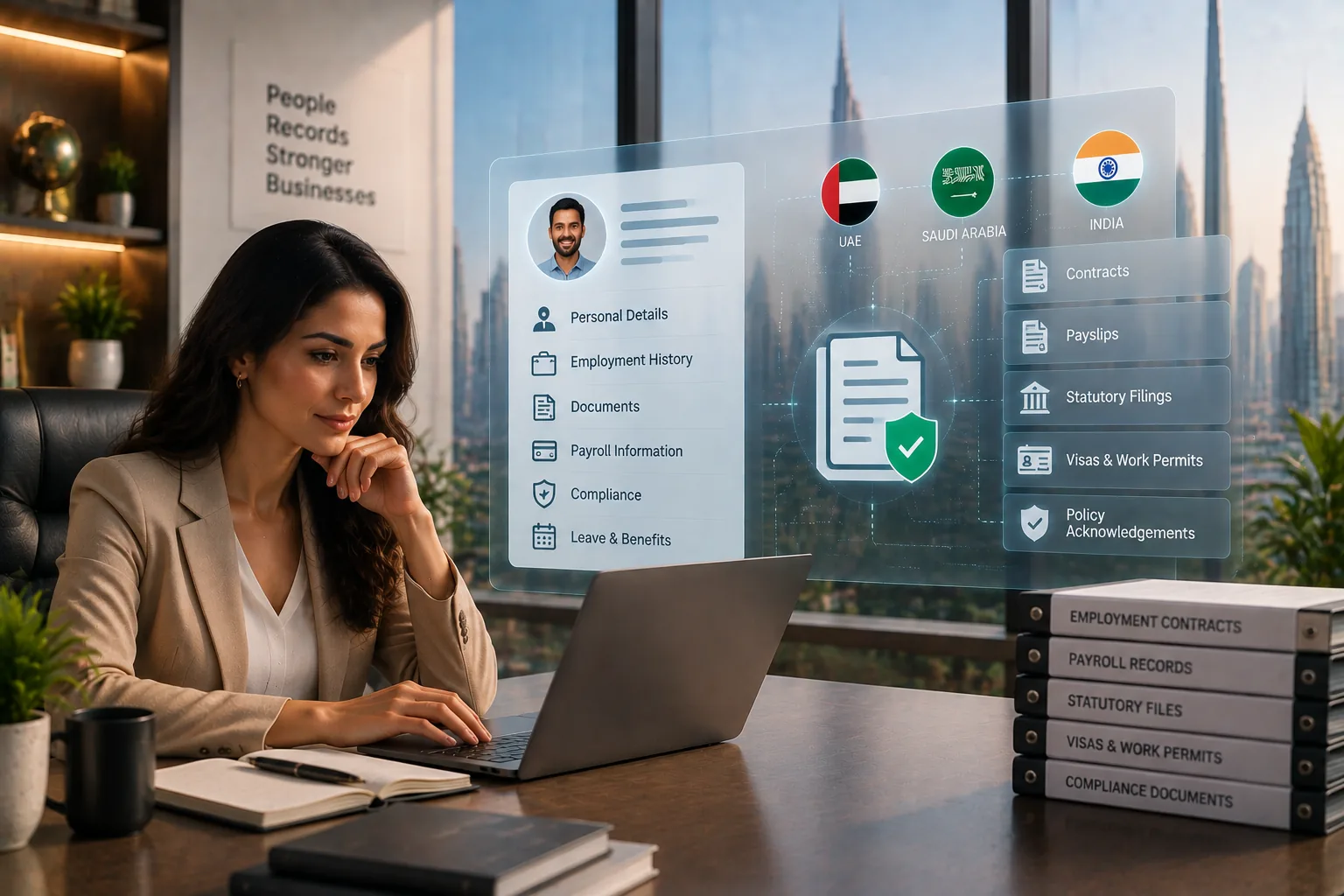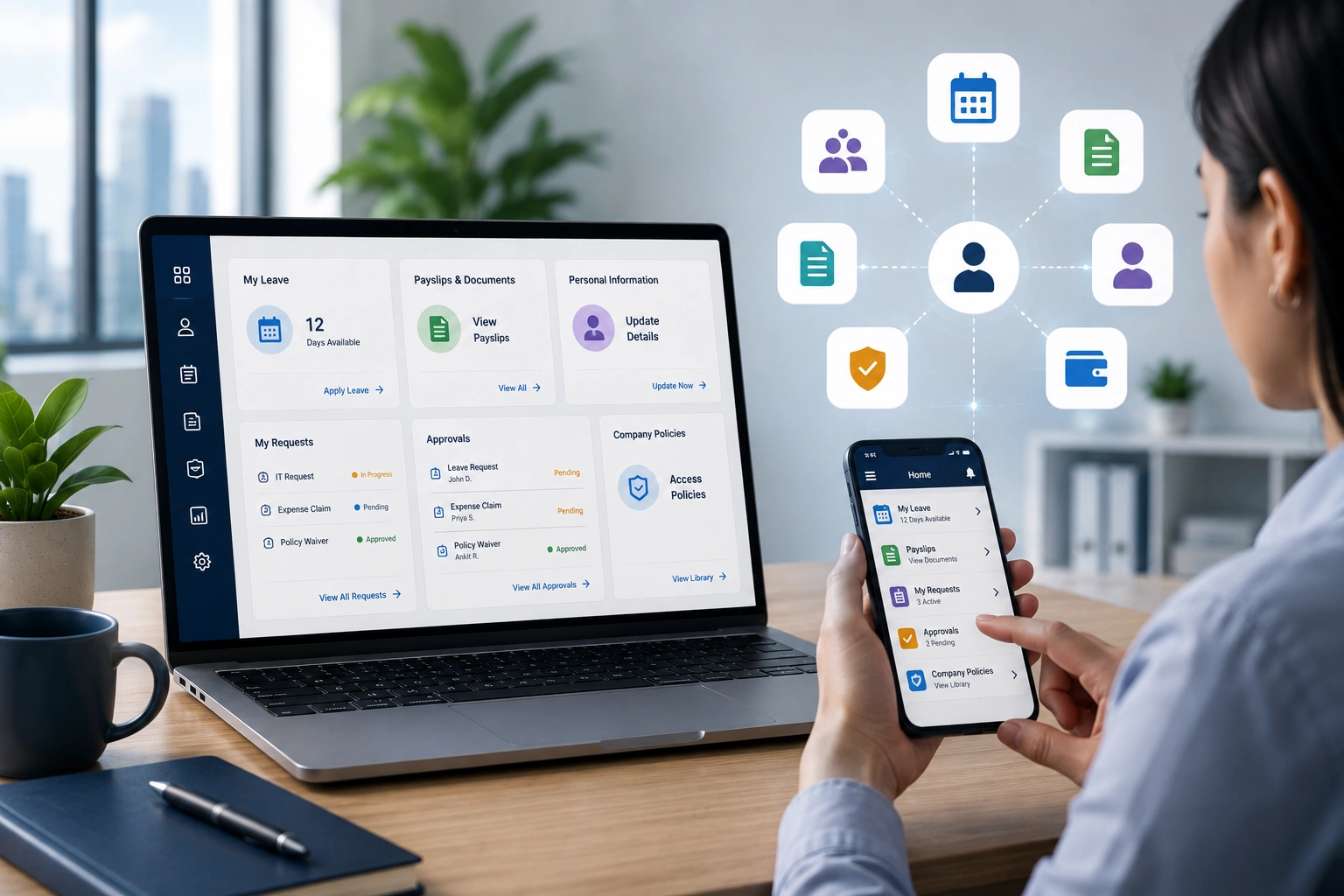

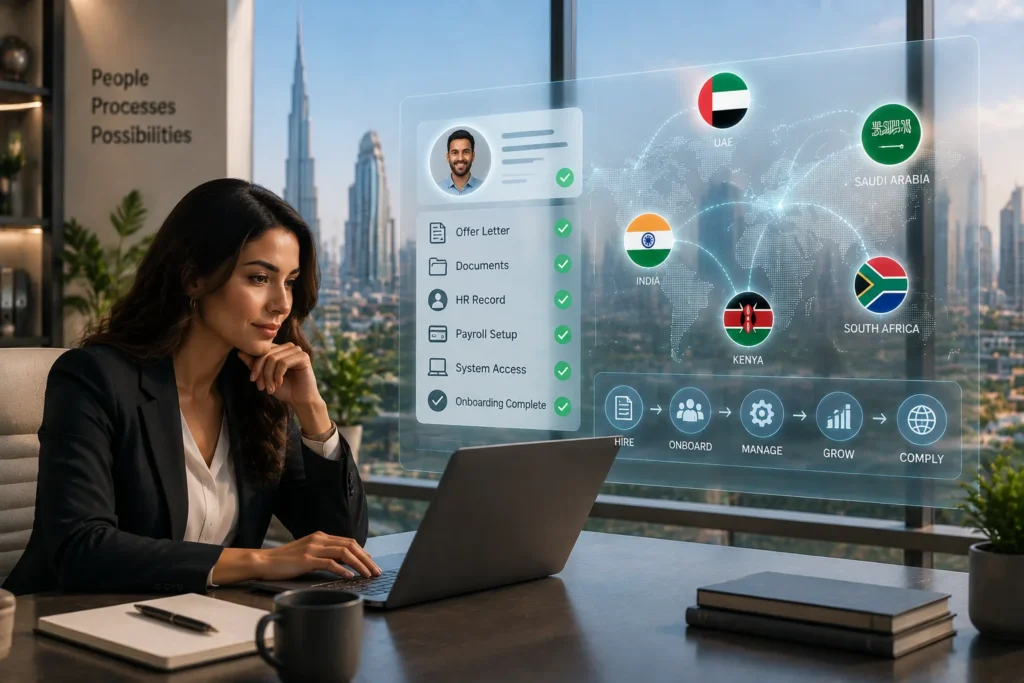
An employee management system is HR software that centralises employee data – including personal details, employment history, documents and org structure – in one system of record. It replaces spreadsheets and shared drives with a single, auditable source of truth that HR, payroll and managers can all draw from, which becomes essential once a company operates across more than one country’s compliance rules. This guide explains what an employee management system covers, how it differs from a basic HR database and from a full HRMS, the features that matter most for multi-country teams, and how centralised employee data directly powers statutory compliance across MENA and India.
Employee Management System vs HR Database vs HRMS: What Each One Is
The three terms are frequently used interchangeably by vendors and HR teams. They describe meaningfully different things. Getting the distinction right before you evaluate software saves significant time and prevents buying the wrong category of tool:
| System | What it is | What it does beyond storing data | Who needs it |
|---|---|---|---|
| HR database | A structured digital store of employee records – essentially a database with forms | Stores data. Does not drive workflows, automate compliance, or connect to payroll | Any company that has moved employee records off paper or Excel but has no other HR system |
| Employee management system | Software that centralises the full employee record and uses it to drive HR processes | Stores data AND automates workflows from it: document collection, approval routing, org chart updates, compliance-linked fields | Companies with 50-500 employees managing multiple document types, org structures, or countries |
| HRMS (Human Resource Management System) | Employee management system plus payroll, leave, attendance, and performance modules | Everything an EMS does, plus payroll calculation, leave workflows, and compliance reporting | Companies that need the full HR operational stack in one platform |
The employee management system is the foundation layer. If the data in it is incomplete or inaccurate, every module built on top of it – payroll, leave, performance – produces incorrect outputs. HROPAL’s core HR platform is built on this principle: the employee record is the single source of truth that feeds payroll calculations, leave entitlements, statutory registrations, and manager reporting in real time. For the full distinction between an EMS and HRMS, see HROPAL’s HRMS buyer guide.
Core Modules of an Employee Management System
A properly built employee management system covers five functional areas. Each one contributes data that other modules depend on:
- Personal data management: the employee database holds each employee’s legal name (exactly as it appears on their government ID), date of birth, nationality, contact details, emergency contacts, and identification document references. In a multi-country operation, this includes passport numbers, national IDs (Emirates ID, Aadhaar, National ID Kenya), and visa/work permit details.
- Employment history: every change to the employment record – role changes, promotions, transfers between entities, salary revisions, department moves – is logged with a timestamp and the approver’s identity. This creates an auditable employment history that HR, finance, and legal can refer to during disputes, audits, or terminations.
- Document storage: employment contracts, offer letters, visa copies, work permits, performance reviews, warning letters, and training certificates are stored against the employee record – not in a shared folder or email chain. Document expiry dates (visa renewals, permit renewals) are tracked and trigger alerts 60-90 days before expiry.
- Organisational structure: the system maintains a live org chart showing reporting lines, department hierarchies, cost centres, and entity-level structure. When an employee moves, the org chart updates automatically from the employment history record – there is no separate org chart to maintain manually.
- Audit trail and access controls: every view, edit, download, and approval is logged. Role-based access controls determine which manager can see which employee’s record – critical for GDPR and MENA data protection compliance. An employee management system without a full audit trail is a compliance liability, not a compliance tool.
Why Spreadsheets Break Down Past 50 Employees – and the Specific MENA Problem
Most HR teams running on spreadsheets and shared drives encounter the same five failure modes as the company grows:
- Version control collapses. Three HR team members editing the same Excel file creates three versions. The payroll team uses one version; the finance team uses another. Discrepancies surface at audit time, not before.
- No audit trail. When a salary figure is challenged in a labour dispute, a spreadsheet cannot prove who changed the number, when, or why. An employee record management system logs every change with a timestamp and user identity.
- Access controls are binary. In a shared folder, either someone has access to everything or nothing. A line manager should be able to see their team’s attendance records but not their salaries. Spreadsheets cannot enforce this distinction.
- No workflow automation. A new joiner in a spreadsheet system still requires HR to manually create the payroll record, update the org chart, add the employee to the leave system, and chase document submission. Every step is a potential error and a delay.
- No compliance linkage. the employee information system in a spreadsheet has no connection to the payroll system. A missing Emirates ID or an incorrect IBAN in the spreadsheet is only discovered when the WPS submission fails on payday.
📌 The MENA-specific problem: a UAE employee’s record must contain a valid IBAN before their first WPS salary transfer. A Saudi employee’s record must capture their hire date to determine whether GOSI System A or System B rates apply. An Indian employee’s record must hold their PF UAN from their previous employer. None of these linkages can be maintained reliably in a spreadsheet as headcount grows across three or more countries.
Must-Have Features Checklist: What to Look for in an Employee Management System for Multi-Country Teams
Use this checklist when evaluating any employee management system. The first section covers non-negotiable features for any deployment; the second covers additional requirements for multi-country or MENA-operating teams:
| Feature | Why it matters | Multi-country requirement? |
|---|---|---|
| Single employee master record | One source of truth for all modules – payroll, leave, performance all read from the same record | Essential – prevents country-by-country data silos |
| Configurable fields per employment type | Contractors, full-time, and part-time employees have different required data fields | Essential – field requirements differ by country and contract type |
| Document expiry tracking and alerts | Visa and work permit renewals are employer obligations in UAE and Saudi Arabia | Critical for MENA – penalties for employing workers on expired permits |
| Role-based access controls (RBAC) | Managers see their team; HR sees all; payroll sees financial fields only | Required for GDPR, UAE PDPL, and India PDPB compliance |
| Full audit trail (all changes logged) | Traceability for labour disputes, audits, and compliance reviews | Required in UAE and Saudi labour law frameworks |
| Org chart auto-generated from employment records | Eliminates manual org chart maintenance; always reflects current structure | Important for multi-entity companies with frequent transfers |
| Integration with payroll module | Employee data flows directly to payroll without manual re-entry | Essential – eliminates the most common source of payroll errors |
| Multi-language interface | Employees in Arabic-speaking markets expect Arabic-language self-service | Critical for UAE, Saudi, Egypt, and Jordan deployments |
| Country-specific statutory field support | Emirates ID for UAE; Iqama for Saudi; PAN/Aadhaar for India; NSSF number for Kenya | Essential for any multi-country operation |
| Document e-signature and collection | New joiners submit and sign documents digitally before day one | Important for remote and distributed teams |
How Employee Data Powers Statutory Compliance Across MENA and India
The employee management system is not a standalone HR tool – it is the data source for every downstream compliance obligation. When the record is complete and accurate, compliance is systematic. When it is incomplete, compliance is manual and error-prone. HROPAL’s Workforce Admin module maintains this data chain across all supported regions.
| Country | Data required in employee record | Downstream compliance it powers |
|---|---|---|
| UAE | Emirates ID number and expiry, UAE bank IBAN (WPS-registered account), visa page and expiry, nationality (for Emiratisation count) | WPS salary transfer; GPSSA registration if UAE national; Emiratisation headcount tracking; visa renewal alerts |
| Saudi Arabia | Iqama number and expiry, hire date (determines GOSI System A or B), nationality, Saudi bank account (for Mudad WPS) | GOSI contribution rate (System A vs B); Mudad WPS file; Nitaqat Saudization headcount; Iqama renewal tracking |
| India | PAN card number, Aadhaar number, PF UAN (from previous employer if applicable), bank account IFSC + number, basic wage (for PF/ESI calculation) | PF contribution (12% of basic wages); ESI registration (if basic below INR 21,000); TDS configuration; Form 16 generation |
| Kenya | National ID or passport, KRA PIN, NSSF number, SHIF number, bank account | PAYE calculation; NSSF Tier I/II contribution; SHIF deduction; Affordable Housing Levy |
For a complete breakdown of how multi-country payroll connects to the employee data record across MENA, Africa, and India, see HROPAL’s multi-country payroll compliance guide.
5 Questions to Ask Before Buying an Employee Management System
- Does one employee record feed all other modules without re-entry? Ask the vendor to demonstrate a new joiner being added and show how that record automatically appears in payroll, leave, and the org chart. If any step requires exporting and re-importing data, the integration is not native.
- Can you configure country-specific fields and document requirements? For a UAE entity, the system should require an Emirates ID and IBAN. For an India entity, it should require a PAN and PF declaration. Ask the vendor to show how mandatory fields differ by country in the same platform.
- What does the full audit trail look like? Ask to see the change log for a specific employee record. It should show who changed what field, from what value to what value, and when – with a named user, not just a system reference.
- How are document expiry dates tracked and communicated? Ask to see how a visa expiry date in an employee record generates an alert 90 days before expiry and who receives that alert – HR, the employee, or both.
- Is the interface available in Arabic? For MENA deployments, the employee self-service experience for Arabic-speaking staff must be available in Arabic. Ask for a live demonstration of the Arabic-language interface, not just a translation setting.
Frequently Asked Questions About Employee Management Systems
What is an employee management system?
An employee management system is HR software that centralises all employee data – personal details, employment history, documents, and org structure – in one system of record. It is the foundational layer of HR software: every other module (payroll, leave, performance) reads its data from the employee management system. It differs from a simple HR database by automating workflows from the data it holds, not just storing it.
What is the difference between an employee management system and HRMS?
An employee management system handles the core employee record: personal data, employment history, documents, and org chart. An HRMS (Human Resource Management System) extends this with operational modules – payroll processing, leave management, attendance tracking, and performance management. The employee management system is the foundation layer inside an HRMS. Companies under 50 employees often start with an EMS before expanding to a full HRMS as they grow.
What is an employee information system?
An employee information system is another term for an employee management system – software that stores and manages employee data including personal details, employment history, qualifications, and documents. The two terms are used interchangeably in most HR contexts. Some vendors use ’employee information system’ to emphasise the data storage and reporting function, while ’employee management system’ implies a broader workflow and process automation capability.
Why do spreadsheets fail for employee record management?
Spreadsheets fail for employee record management because they have no audit trail (you cannot see who changed a figure or when), no access controls (any user with file access can see everything), no workflow automation (every process step is manual), and no integration with payroll or compliance systems. A missing IBAN or incorrect visa expiry date in a spreadsheet is invisible until the WPS submission fails or a work permit lapses – by which point the compliance breach has already occurred.
What employee data is required for compliance in the UAE?
For UAE compliance, an employee’s record must contain: Emirates ID number and expiry date (for Emiratisation tracking and work permit management), UAE bank account IBAN at a WPS-registered bank (required before the first salary transfer under Ministerial Resolution No. 340), visa page and expiry date (for work permit renewal tracking), and nationality (to determine whether the employee counts toward the Emiratisation quota). For UAE national employees, GPSSA registration details are also required.
How many employees before an employee management system becomes necessary?
Most HR teams find that spreadsheet-based employee record management becomes unreliable at 50 to 100 employees, particularly when the team operates across more than one site or country. At this scale, version control issues, missing audit trails, and manual compliance errors accumulate faster than a small HR team can manage. For companies operating across two or more countries – even at 20 to 30 employees per country – the complexity of multi-country document requirements and statutory registrations makes a proper employee management system necessary from the outset.