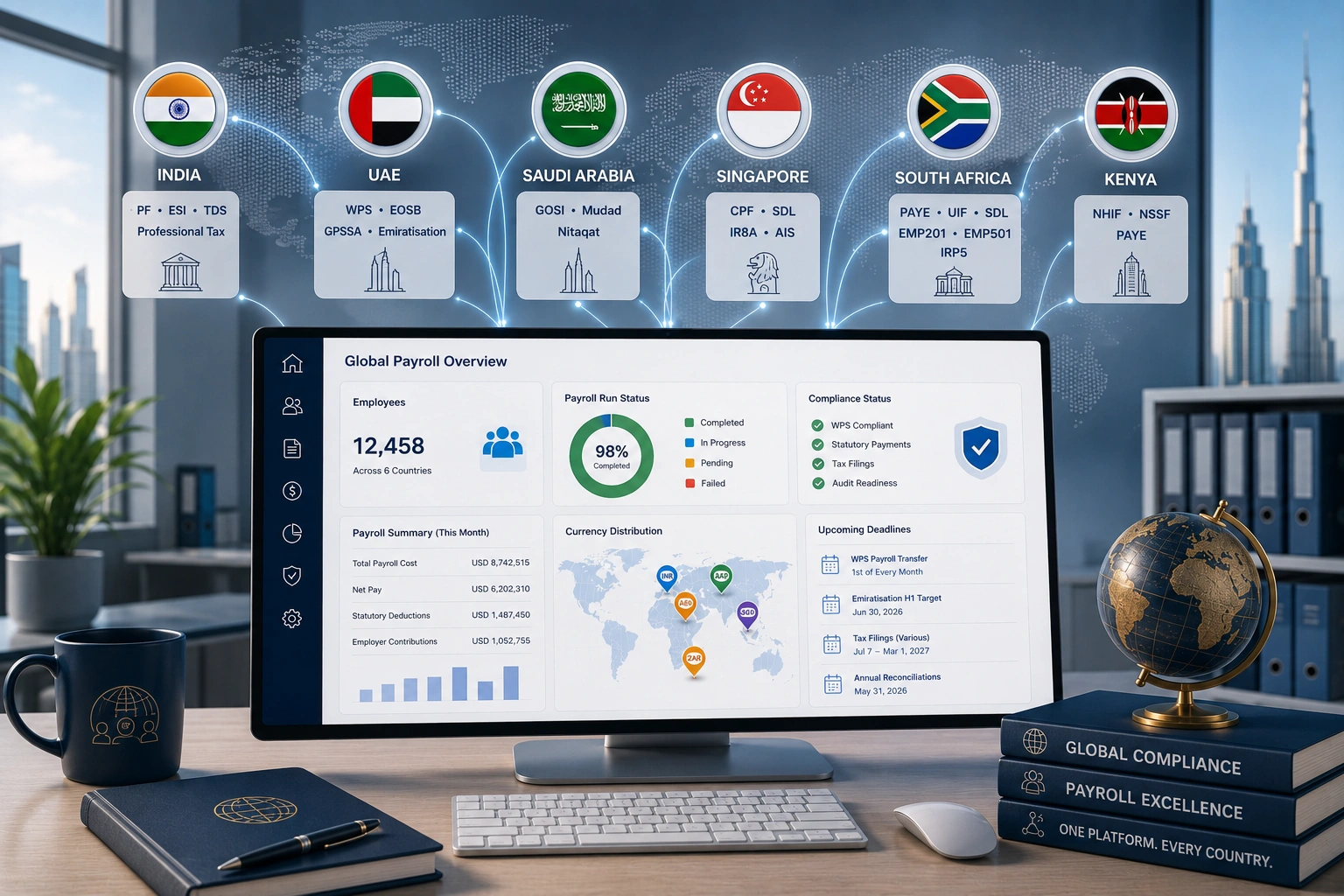


Expanding across MENA and India means running payroll under fundamentally different statutory frameworks: WPS in the UAE, GOSI in Saudi Arabia, PF and ESI in India, NHIF and NSSF in Kenya. A single missed deadline can trigger fines, frozen work permit applications, or a tax authority audit. Use this payroll compliance guide to stay ahead of each market.
What Is Payroll Processing: Why Multi-Country Makes It Exponentially Harder
What is payroll processing: the end-to-end calculation, deduction, and payment of employee wages in line with local statutory obligations. Across three or four countries, each with different wage definitions, contribution thresholds, and filing calendars, it becomes a compliance operation that most generic tools are not built for. HROPAL’s broader guide on HR strategies for global workforces covers the wider picture.
Payroll Compliance Requirements by Country: UAE, Saudi Arabia, India, and Kenya
The table below covers primary payroll compliance obligations, key deadlines, and common penalty exposures per market. Always verify before entering a new country.
| Country | Key statutory obligations | Key deadline | Common penalty exposure |
|---|---|---|---|
| UAE | WPS electronic salary transfer (MOHRE-registered employers); End of Service Gratuity (EoSG) for employees completing 1+ year; GPSSA contributions for UAE nationals | WPS: within 15 days of due date | AED 1,000/employee for salary delays; work permit suspension after 60 days; referral to public prosecutor for serious violations |
| Saudi Arabia | GOSI contributions (11.75% employer + 9.75% employee); Saudi WPS via Mudad platform; Nitaqat (Saudization): minimum percentage of Saudi nationals in workforce | WPS: by 10th of month; GOSI: monthly | SAR 3,000/employee/month for late salaries; Nitaqat violations = work permit and visa restrictions |
| India | PF: 12% employer + 12% employee on basic wages (mandatory at 20+ employees); ESI for employees earning up to Rs 21,000/month; TDS on salary; Professional Tax (state-level) | PF and ESI: 15th of following month; TDS: 7th of following month | 12% p.a. interest on late PF; up to 100% of arrears as damages; imprisonment for persistent default (Section 14(2A)) |
| Kenya | NHIF (National Hospital Insurance Fund): mandatory health contributions; NSSF (National Social Security Fund): pension; PAYE income tax deduction at source | PAYE: 20th of following month; NHIF/NSSF: monthly | KRA penalty interest on late PAYE; fines for NHIF/NSSF non-registration or under-reporting |
📌 UAE regulatory source: WPS penalties are governed by Ministerial Resolution No. 598 of 2022. Fines start at AED 1,000 per employee for delayed salary payments. Serious or repeated violations can result in criminal prosecution. Source: UAE Government – Payment of Wages (u.ae)
What Breaks When Payroll Is Not Localised: Four Common Scenarios
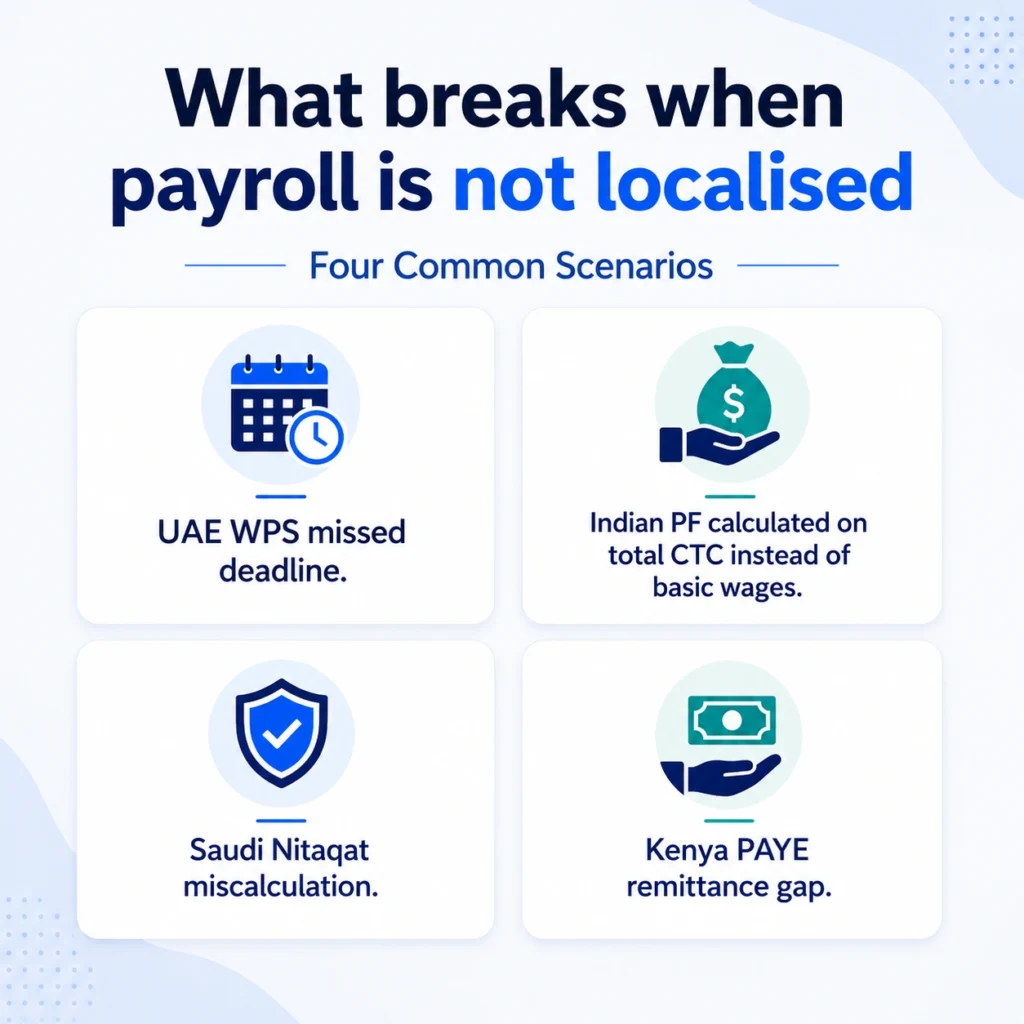
These are the errors that cost regional teams the most time and money:
- UAE WPS missed deadline. A salary file not transferred through a MOHRE-approved WPS channel by the due date flags the employer in MOHRE’s system. Work permit applications are blocked within 60 days, stalling any planned hiring.
- India PF calculated on total CTC instead of basic wages. PF contributions are calculated on ‘basic wages’ as defined under the EPF Act, not the full cost-to-company. Employers who apply the 12% to total CTC are both over-contributing and exposing themselves to retrospective EPFO audit queries on structuring.
- Saudi Nitaqat miscalculation. Companies that fall below the required percentage of Saudi nationals in their workforce face restrictions on new visa issuance and work permit renewals, an operational blocker for any team scaling quickly in KSA.
- Kenya PAYE remittance gap. Companies new to Kenya often miss the 20th-of-the-month PAYE deadline when onboarding their first employees. KRA penalty interest accumulates monthly from day one of the default.
📌 India regulatory source: Under Section 7Q of the EPF Act 1952, late PF contributions attract 12% p.a. interest. Damages under Section 14B can reach up to 100% of the arrears for extended defaults. Source: EPFO, India (epfindia.gov.in)
In-House, Payroll Outsourcing, or HRMS-Powered Compliance: How to Decide
The right approach depends on how many markets you operate in, how fast you’re expanding, and whether you need real-time compliance visibility. Payroll outsourcing via payroll processing providers solves short-term entry problems but limits control as you scale.
| Option | Best for | Main risk | Cost note |
|---|---|---|---|
| In-house payroll team | Single market, stable headcount, deep local expertise available | Knowledge gaps and manual errors when entering a new country | Scales with headcount; becomes costly fast in multi-country setups |
| Payroll outsourcing | Short-term market entry or pilot operations in a new country | Visibility and control limitations; dependency on provider’s compliance quality | Per-employee monthly fee; add-ons for compliance filings in each market |
| HRMS-powered compliance | Multi-country operations and ongoing regional expansion | Setup time required to configure local tax tables and contribution rates | Lowest per-country cost once live; compliance updates handled within the platform |
For companies already running across UAE, Saudi, India, or Africa, an automated payroll management platform that handles WPS, GOSI, PF, and local tax tables in one system removes the per-country compliance risk that manual approaches carry.
Payroll Compliance Checklist Before and After You Enter a New Market
Use this as a working checklist for each new country you add:
Before Launch: Statutory Setup
- Register with local statutory bodies: MOHRE (UAE), GOSI (Saudi), EPFO and ESIC (India), NHIF and NSSF (Kenya).
- Confirm the correct wage definition for contribution calculations, as it differs significantly between countries and cannot be assumed from your existing payroll structure.
- Identify approved payment channels: WPS requires UAE Central Bank-approved banks or exchange houses; Saudi WPS operates through the Mudad platform.
- Configure payroll software india rates and regional tax tables before the first payroll run. Corrections after the fact attract retrospective penalties.
Monthly Obligations
- File all payroll compliance returns by the statutory deadline for each country. Missing by one day triggers interest and penalty cycles.
- Reconcile contributions against payslips before submission, not after. Errors discovered post-submission require amended filings and attract EPFO and GOSI scrutiny.
- Track headcount changes that cross statutory thresholds: India PF and ESI activate at specific employee counts; missing the registration window is itself a violation.
Annual Review
- Audit Saudi Nitaqat (Saudization) percentages against current headcount before the annual renewal period.
- Review UAE End of Service Gratuity accruals for all employees approaching or beyond five-year tenures, where the rate increases.
Use your HR analytics and compliance reporting platform to flag upcoming deadlines, threshold changes, and year-on-year contribution trends across all active markets.
Frequently Asked Questions
Q1. What is payroll compliance?
Payroll compliance is the process of calculating, deducting, and remitting employee wages and statutory contributions (such as social insurance, income tax, and provident fund) in accordance with each country’s labour and tax laws. Non-compliance triggers fines, audits, and in severe cases, criminal liability for company directors.
Q2. What is payroll processing and how does it differ from compliance?
What is payroll processing: the operational task of calculating salaries, generating payslips, and transferring funds to employees. Payroll compliance is the legal layer on top, ensuring those payments meet statutory obligations (correct contribution rates, correct deadlines, correct channels). Most payroll errors occur when teams treat them as the same function.
Q3. When should a company consider payroll outsourcing?
Payroll outsourcing makes sense for market entry or one-off expansion into a country where building local expertise is not yet justified. Once a company has 50+ employees in a market or operates across three or more countries, payroll processing providers typically create more overhead and compliance risk than an integrated HRMS.
Q4. How do payroll processing providers compare to an HRMS for multi-country operations?
Payroll processing providers handle execution in a specific market but rarely integrate compliance rules for multiple countries in a single platform. An HRMS with native multi-country payroll compliance builds WPS, GOSI, PF, and local tax tables into one system, giving finance and HR teams a single source of truth across markets.
Q5. What is the best payroll software for India for a company also operating in MENA?
Payroll software india requirements include PF, ESI, TDS, and Professional Tax handling. A company also running in UAE or Saudi needs WPS and GOSI capability in the same system. India-only platforms like Keka, GreytHR, or Darwinbox cannot support MENA compliance; a multi-country HRMS is required for companies operating across both regions.
Q6. What are the biggest payroll compliance risks when entering UAE or Saudi Arabia?
For UAE, missing the WPS salary transfer deadline is the most common trigger: fines begin at AED 1,000 per employee and escalate to work permit suspension within 60 days. For Saudi Arabia, Nitaqat (Saudization) miscalculation is the most operationally disruptive: falling below the required ratio restricts new work permits and can freeze expansion plans.