

The most important thing to understand about the nps new rules 2026 is where they came from. The Union Budget presented in February 2026 made no changes to the National Pension System at all. Every material change of the past year has come from the Pension Fund Regulatory and Development Authority through regulation and circular, which is precisely why so many payroll teams have not yet actioned them. This guide sets out what changed, what it means for payroll and benefits administration, and what HR should do next.
A Quick Refresher: What the National Pension System Actually Is
The National Pension System is a regulated, market-linked, portable retirement savings scheme administered by PFRDA. Employees hold a Permanent Retirement Account Number that follows them across employers, professional pension fund managers invest the contributions, and the corpus funds retirement income through a mix of lump sum and annuity. For employers it occupies a specific slot: unlike provident fund it is voluntary, unlike gratuity it is defined contribution, and it can be structured inside CTC to improve an employee post-tax outcome at no extra employer cost.
What Actually Changed: The NPS Updates 2026 in One Table
PFRDA notified amendments to the Exits and Withdrawals Regulations in December 2025, with further circulars through 2026. The changes affecting private sector employees are below.
| Area | Earlier position | Revised position |
| Lump sum at normal exit (non-government, including corporate sector) | Up to 60 percent lump sum, minimum 40 percent annuity | Up to 80 percent lump sum, minimum 20 percent annuity |
| Full lump sum threshold at normal exit | Corpus up to Rs 5 lakh | Corpus up to Rs 8 lakh |
| Lock-in for premature exit (All Citizen Model) | 5 years | Removed |
| Vesting period (All Citizen Model) | Till age 60 | 15 years or age 60, whichever is earlier |
| Vesting period (corporate sector) | Till retirement or superannuation | Unchanged |
| Maximum entry and exit age | Entry 70, exit 75 | Raised to 85 |
| Partial withdrawals before age 60 | 3 times, no minimum interval | 4 times, with a 4 year gap between withdrawals |
| Partial withdrawal for medical reasons | Restricted to a specified critical illness list | Broadened to medical treatment and hospitalisation generally |
| Continuation beyond 60 | 15 day prior intimation required | Automatic, intimation requirement removed |
| Borrowing against the corpus | Assignment or pledge largely void | Lien permitted up to 25 percent of the subscriber own contribution |
Sourced from the PFRDA press release on key amendments to the Exits and Withdrawals Regulations, December 2025, and subsequent PFRDA circulars. Government sector normal exit remains at 60 percent lump sum and 40 percent annuity, though the corpus thresholds have been revised in line with the above.
Three further developments matter: the Multiple Scheme Framework, live since October 2025, allows multiple schemes under one PRAN with higher equity exposure; a revised Central Recordkeeping Agency charge structure took effect on 1 July 2026; and in May 2026 PFRDA relaxed annuity surrender rules in defined situations including critical illness. Taken together, the nps exit rules 2026 are far more flexible than the regime most employees were briefed on. Full text is published by PFRDA.
Impact for Payroll and Benefits Teams
The changes above are subscriber-facing. The nps payroll compliance changes sit on the tax side, and they are easy to get wrong.
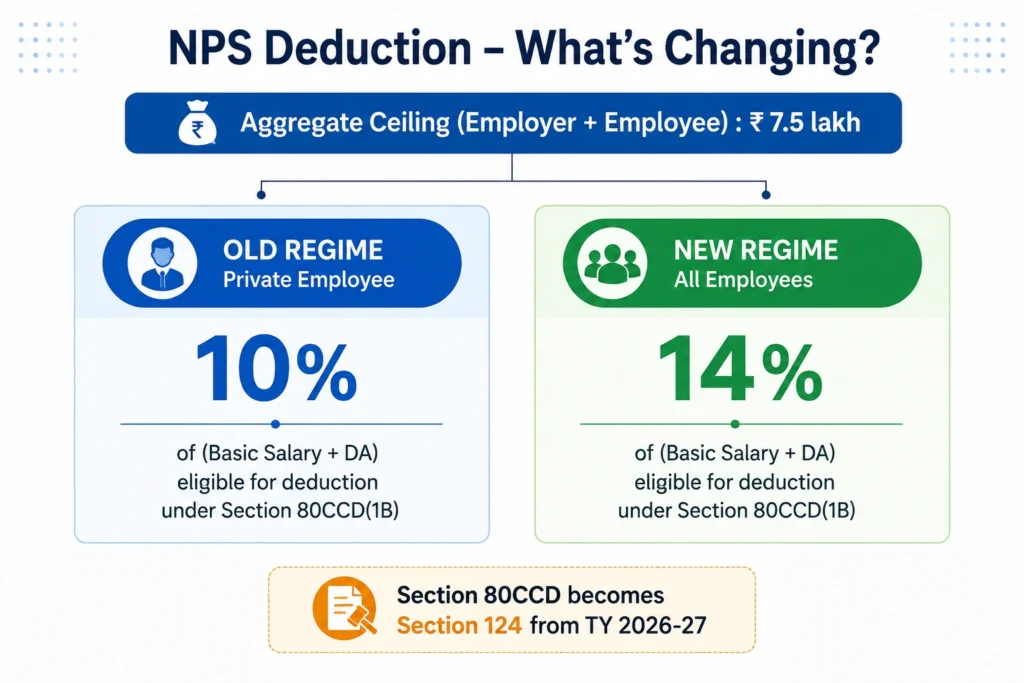
- The employer nps contribution deduction is uniform at 14 percent under the new tax regime, on basic pay plus dearness allowance, for government and private sector employees alike. Under the old regime it stays at 10 percent for non-government employees. A payroll engine applying one flat percentage across both regimes is producing incorrect TDS.
- The Rs 7.5 lakh aggregate ceiling still applies across employer NPS, provident fund and superannuation combined, with any excess taxable as a perquisite along with its accretion. This bites at senior salary bands and is among the most commonly missed checks in Indian payroll.
- Section references change from Tax Year 2026-27. The Income-tax Act 2025 took effect on 1 April 2026 and Section 124 replaces Section 80CCD. Limits are unchanged, but payroll systems, Form 16 templates and CTC letters all carry the old references.
So the section 80ccd(2) limit must be configured by regime rather than globally, and the aggregate perquisite test must run in-cycle rather than at year end. Where NPS sits inside CTC, an accurate payroll processing engine is what stops a well-intentioned benefit becoming a March reconciliation problem. Current limits are published by the Income Tax Department.
What Employees Benefit from the New Rules
The direction of travel in the new nps rules for employees is flexibility. The oldest objection to the scheme, that money went in and could not come out, is now materially weaker.
- More control at exit: Up to 80 percent as a lump sum instead of 60 percent, with Systematic Lump Sum Withdrawal and Systematic Unit Redemption enabling phased drawdown rather than a single event.
- Liquidity without exiting: Four partial withdrawals before 60, a broadened medical purpose, and the option to borrow against up to 25 percent of own contributions.
- A longer runway: Entry and exit ages extended to 85 let subscribers keep a compounding corpus invested well past traditional retirement instead of annuitising on a fixed date.
- Portability and professional management: The PRAN follows the employee across employers, and fund management sits with regulated pension fund managers rather than the employer.
NPS Beyond Tax Savings
Most internal communication still frames NPS as a tax instrument, and that framing now undersells it. Under the new tax regime, where HRA, Section 80C and most familiar deductions no longer apply, employer contribution to NPS is one of the last meaningful levers a salaried employee has. It has moved from one option among many to a structural part of compensation design.
The more useful frame is financial wellness. An employee with a portable, professionally managed corpus and the flexibility to reach part of it in an emergency is in a stronger position than one relying on provident fund alone, and employers that treat retirement readiness as a measurable outcome tend to see it in engagement and retention data. Our note on turning workforce data into strategic insight covers how to build that measurement.
Practical Guidance: A Checklist for HR Teams
Five actions for this quarter:
- Audit payroll configuration first: Confirm the 14 and 10 percent limits apply by regime, the Rs 7.5 lakh aggregate check is live, and section references are current. A one hour exercise that prevents a year end problem.
- Refresh employee communication: Most employees last heard about NPS when the 60 to 40 split applied. Send a short, plain-language note on exit, partial withdrawals and the age limit.
- Explain CTC mechanics honestly: When NPS sits inside CTC, take-home falls even though total value rises. Employees who are not told this read it as a pay cut.
- Make the numbers visible: A live view of employer and employee contributions in an employee self-service portal does more for participation than an annual email.
- Brief people managers, not just employees: The early-investing and compounding argument lands better in a one to one than in an HR mailer, and managers need the talking points.
How HROPAL Supports NPS Administration
NPS sits where payroll accuracy, benefits administration and statutory reporting meet, which is exactly where fragmented HR systems fail.
- Accurate contribution processing: NPS contributions are computed in the same payroll run as provident fund, professional tax and TDS, with regime-aware deduction limits and the aggregate perquisite ceiling applied automatically.
- Benefits administration: Contribution structures, eligibility rules and CTC components are managed centrally through accruals and benefits management rather than in parallel spreadsheets.
- Compliance and reporting: Statutory reports, contribution registers and Form 16 inputs come from a single dataset, so what employees see matches what is filed.
- Self-service visibility: Employees view contributions and benefit details on web and mobile without raising a ticket, cutting query volume during declaration season.
- Multi-country readiness: India NPS and provident fund sit in the same engine as UAE WPS, Saudi GOSI and other regional rules, on one dashboard and one audit trail.
The Bottom Line
The nps updates 2026 have quietly made the National Pension System a more flexible and more competitive benefit than it was two years ago, and they arrived through regulation rather than a Budget announcement. That is the risk for HR teams. Nothing forced an internal review, so most organisations have not had one.
The organisations that get value from this will treat NPS as a designed benefit rather than an administered deduction: payroll configuration correct by regime, communication employees actually understand, and visibility that lets people watch their own corpus grow. If your setup has not been reviewed against the current rules, request a callback and the HROPAL team will walk through your contribution logic, deduction limits and employee communication against what the regulations now require.
Frequently Asked Questions
Q1. What are the new NPS rules in 2026?
The most significant nps new rules 2026 came from PFRDA, not the Union Budget. Non-government subscribers, including corporate sector employees, can now take up to 80 percent of the corpus as a lump sum at normal exit instead of 60 percent, with only 20 percent annuitised. The full lump sum threshold rose from Rs 5 lakh to Rs 8 lakh, the maximum entry and exit age moved to 85, and partial withdrawals are now permitted four times before age 60.
Q2. How much employer NPS contribution is tax free in 2026?
Under the new tax regime, employer contributions to an employee NPS Tier I account are deductible up to 14 percent of basic pay plus dearness allowance, for government and private sector employees alike. Under the old regime the limit stays at 10 percent for non-government employees. A separate aggregate ceiling of Rs 7.5 lakh a year applies across employer NPS, provident fund and superannuation combined, and any excess is taxable as a perquisite. Payroll must test both limits, not just the percentage.
Q3. Do the new NPS exit rules apply to corporate sector employees?
Yes, in part. The higher 80 percent lump sum and the revised corpus thresholds apply to the corporate sector as well as the All Citizen Model. However, the vesting period for corporate sector subscribers stays linked to retirement or superannuation rather than the 15 year or age 60 rule that now applies to All Citizen Model subscribers. Communicate that distinction clearly, because many employees hold both a corporate and an individual account.
Q4. What should HR teams change in payroll because of the NPS 2026 updates?
Confirm your payroll applies the correct section 80ccd(2) limit by regime, because a single flat percentage across both regimes is the most common nps payroll compliance error. Add an in-cycle check for the Rs 7.5 lakh aggregate employer contribution ceiling so any excess is treated as a perquisite in the same pay run. Then map your system to the Income-tax Act 2025 section references applying from Tax Year 2026-27 and refresh CTC communication templates.
Q5. Is NPS still worth it for employees under the new tax regime?
For most salaried employees it is now more attractive, not less. Employer contribution under Section 80CCD(2) is one of the very few deductions surviving intact under the new tax regime, at 14 percent of basic pay plus dearness allowance. On a basic salary of Rs 15 lakh that is a deduction of up to Rs 2.1 lakh against taxable income at no extra employer cost. The 2026 flexibility changes also weaken the old objection that money entering NPS was locked away.
This article is for general information and does not constitute tax, legal or investment advice. Regulatory positions are stated as at August 2026 based on PFRDA regulations and circulars and the Income-tax Act 2025. Readers should verify the current position with PFRDA, the Income Tax Department or a qualified adviser before acting.