
UAE labour law compliance in 2026 is more demanding than any prior year: the WPS grace period has been permanently removed, Emiratisation penalties have reached their highest level, and the final year of the four-year Emiratisation plan ends on 31 December. This uae hr compliance calendar consolidates every HR deadline, public holiday, government reporting obligation, and quarterly audit task into one reference guide for CHROs, payroll managers, and compliance teams.
📌 Official sources: All deadlines in this calendar are based on published MOHRE directives and UAE government announcements. Islamic holiday dates are based on confirmed moon-sighting outcomes where known, and astronomical prediction otherwise. Always verify through MOHRE (mohre.gov.ae) and the UAE Government portal (u.ae) before finalising your company calendar.
UAE Labour Law 2026: Regulatory Framework at a Glance
Three legal instruments govern the majority of UAE private-sector HR obligations in 2026:
- Federal Decree-Law No. 33 of 2021 (effective February 2, 2022): the primary uae employment law governing employment contracts, working hours, leave, end-of-service gratuity, and employee rights. Replaces the 1980 Labour Law.
- Ministerial Resolution No. 340 of 2026 (effective June 1, 2026): removes the 15-day WPS grace period. All wages must now be transferred through WPS by the 1st of each month. No exceptions.
- Cabinet Resolution No. 18 of 2022 and No. 44 of 2024 (Emiratisation): mandates progressive Emiratisation targets of 2% per year for companies with 50+ employees, and minimum Emirati hires for companies with 20-49 employees in 14 priority sectors.
HROPAL’s UAE HR software is configured for all three – WPS SIF generation, Emiratisation headcount tracking, and EOSB accrual calculations are built into the core payroll workflow. For the wider regional picture, see HROPAL’s HR compliance strategies for global workforces guide.
UAE Public Holidays 2026: Official and Confirmed Dates
The UAE observes eight holiday occasions in 2026, totalling at least 12 official days off. Private-sector and public-sector entitlements may differ for some occasions. Dates confirmed by MOHRE and official moon-sighting committee where applicable:
| Holiday | Date(s) | Private sector entitlement | Notes |
|---|---|---|---|
| New Year’s Day | January 1 (Thu) | 1 day | Thursday; many employees enjoyed a 4-day weekend |
| Eid Al Fitr | March 19-22 (Thu-Sun) | 3 days (extended to 4 if Ramadan = 30 days) | MOHRE confirmed March 19-21 for private sector; extended to March 22 confirmed |
| Arafat Day (Day of Arafat) | May 26 (Tue) | 1 day | Confirmed by official moon sighting |
| Eid Al Adha | May 27-29 (Wed-Fri) | 3 days | Confirmed by official moon sighting; 6-day break with weekend |
| Islamic New Year (Hijri 1448) | ~June 16 (Tue) | 1 day | Predicted; exact date subject to moon sighting; may be moved to Monday |
| Prophet’s Birthday (Mawlid Al Nabi) | ~August 25 (Tue) | 1 day | Predicted; exact date subject to moon sighting; may be moved to Monday |
| Commemoration Day (Martyrs’ Day) | November 30 (Mon) | 1 day | Fixed date; annual public holiday |
| UAE National Day (55th anniversary) | December 2-3 (Wed-Thu) | 2 days | 55th UAE Union anniversary; 4-day break with weekend |
📌 Payroll note: Under Federal Decree-Law No. 33/2021, employees who work on a public holiday are entitled to time off in lieu or an additional day’s pay. Ensure your payroll system flags public holiday working before each payroll run.
Emiratisation Deadlines 2026: What Every UAE Employer Must Track
⚠ Critical 2026 deadline: June 30 was the H1 Emiratisation target date. From July 1, financial penalties apply to companies that failed to achieve the required 1% increase in skilled Emirati workforce. Penalties reached AED 108,000 per unfilled position in 2026. Source: MOHRE / Gulf News
| Deadline | Obligation | Who it applies to | Penalty if missed |
|---|---|---|---|
| June 30, 2026 (H1) | 1% increase in Emirati skilled workforce representation; 8% Emirati skilled ratio milestone | Mainland companies with 50+ employees | From July 1: financial penalties apply. AED 108,000 per unfilled position per year. |
| December 31, 2026 (Full year) | Total 2% annual increase; 10% Emirati skilled workforce target by year-end | Mainland companies with 50+ employees (final year of 4-year plan) | AED 108,000 per unfilled position per year; work permit suspensions; anti-fraud enforcement |
| Throughout 2026 | Minimum 2 Emirati employees in skilled roles | Mainland companies with 20-49 employees in 14 priority sectors (Year 2) | AED 108,000 per unfilled position per year |
| Monthly (ongoing) | GPSSA contributions for UAE nationals; Nafis subsidy reconciliation | All mainland employers with Emirati staff | Penalties for missed GPSSA contributions; Nafis disqualification |
Important notes: (1) Nafis programme extended to 2040 (announced April 6, 2026); an updated Nafis phase launches in September 2026 with enhanced benefits. (2) Only WPS-paid, GPSSA-registered, genuinely employed Emiratis in skilled roles count toward quotas. (3) Fake Emiratisation is now a criminal offence: AED 20,000-100,000 per fictitious hire, with prosecution risk.
WPS Compliance 2026: The New Monthly Payroll Deadline
Under Ministerial Resolution No. 340 of 2026, the previous 15-day grace period no longer exists. Use HROPAL’s payroll management module to generate and validate the SIF file automatically, with submission by the 29th of each month to ensure processing completes before the 1st.
| Period | WPS deadline | Old rule (pre-June 2026) | New rule (June 2026 onwards) |
|---|---|---|---|
| Jan-May 2026 | Within 15 days of wage period end | Grace period: 15 days | Old rule applied (Resolution 340 not yet in force) |
| June 2026 onwards | 1st of the following month | 15-day grace period | NO grace period. Penalties from day 2. |
Practical rule: Close payroll by the 25th of each month. Submit the SIF to your WPS agent by the 29th/30th. Allow 1-2 business days for bank processing before the 1st of the following month.
UAE HR Compliance Calendar 2026: Month-by-Month Reference
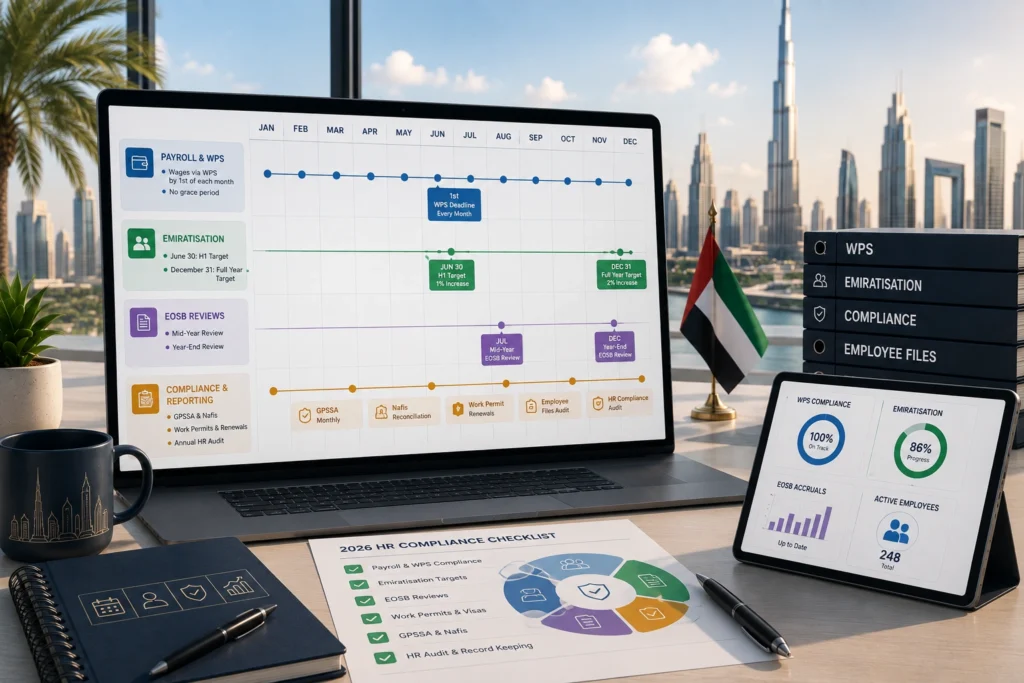
The master calendar below consolidates all HR deadlines, public holidays, and compliance tasks for the full year. Tasks are colour-coded: blue = public holiday, amber = Emiratisation, green = payroll/WPS, white = general HR task.
| Month | Key compliance events | Action required |
|---|---|---|
| January | 🔴 Jan 1: New Year’s Day (public holiday) | Ensure Jan 1 is excluded from payroll working days |
| Annual salary review cycle opens | Issue increment letters; update payroll immediately | |
| Annual leave balance rollover | Apply carry-forward rules; identify employees approaching lapse | |
| Medical insurance renewal peak (many policies renew Jan/Feb) | Confirm continuous DHA/HAAD coverage for all employees | |
| February | ~Feb 18: Ramadan begins | Reduce working hours by 2 hrs/day for Muslim employees (uae labour law requirement) |
| H1 Emiratisation gap analysis | Calculate current Emirati skilled headcount vs June 30 target | |
| Employment contract annual review | Verify all contracts reflect Federal Decree Law No. 33/2021 | |
| March | Mar 19-22: Eid Al Fitr (public holiday) | Confirm MOHRE’s official private-sector entitlement; update payroll |
| Mar 31: Q1 internal Emiratisation check | Verify headcount progress vs June 30 target | |
| April | Work permit/visa expiry review (for permits expiring in Q2/Q3) | Begin renewal process at least 60 days before expiry |
| Q1 payroll audit | Verify WPS submission records, GPSSA contributions, leave deductions | |
| May | May 26: Arafat Day (public holiday) | Government and private sector; payroll adjustment |
| May 27-29: Eid Al Adha (public holiday) | 3-day holiday (6-day break with weekend); payroll adjustment | |
| WPS payroll close preparation | Before June 1: ensure June payroll closes by May 29/30 | |
| June | Jun 1: Ministerial Resolution 340 in force | New WPS deadline: salaries by 1st of month; no grace period |
| ~Jun 16: Islamic New Year Hijri 1448 (public holiday) | Verify exact date via MOHRE official announcement | |
| Jun 30: Emiratisation H1 DEADLINE | 1% increase in skilled Emirati workforce must be achieved by this date | |
| July | Jul 1: Emiratisation penalties begin | Companies that missed June 30 target face financial penalties from today |
| Mid-year EOSB accrual review | Audit gratuity accruals for all employees; flag anomalies | |
| Annual leave planning: H2 push | Employees with significant unused leave balances – initiate planning now | |
| August | ~Aug 25: Prophet’s Birthday (public holiday) | Verify exact date via MOHRE official announcement |
| Work permit expiry review (for permits expiring Oct-Dec) | Begin renewal process at least 60 days in advance | |
| September | Nafis updated phase launches | Review updated Nafis eligibility, subsidy rates, and reporting requirements |
| Annual performance appraisal cycle preparation | Set review dates, configure appraisal platform, communicate to managers | |
| Q3 HR compliance audit | Leave records, WPS submissions, GPSSA contributions – full H1+Q3 review | |
| October | Work permit renewals: Q1 2027 planning | Track all employee permits expiring January-March 2027; begin renewal now |
| Annual HR compliance review preparation | Prepare for year-end contract review, leave settlements, EOSB calculations | |
| November | Nov 30: Commemoration Day (public holiday) | Fixed date public holiday; plan November payroll accordingly |
| Year-end payroll preparation | Verify all salary components, allowances, and deductions are current | |
| Medical insurance renewal review | For policies renewing in Q1 2027: begin broker discussions now | |
| December | Dec 2-3: UAE National Day (public holiday) | 55th UAE Union anniversary; 2-day holiday; 4-day break with weekend |
| Dec 31: Emiratisation full-year DEADLINE | 2% annual increase complete; 10% skilled workforce target for 50+ companies | |
| Annual leave balance settlement | Employees must take outstanding leave or receive encashment per contract terms | |
| Year-end EOSB calculations | Calculate end-of-service accruals for all employees; update provisions | |
| Employment contract compliance review | Verify all contracts are uae employment law-compliant before January |
Quarterly HR Compliance Checklists
Q1 (January – March):
- Payroll: WPS submissions for Jan-Mar under old 15-day rule (Resolution 340 applies from June); verify GPSSA contributions for UAE nationals.
- Leave: Apply annual leave carry-forward policy; identify employees approaching lapse thresholds.
- Medical insurance: Confirm all employees have active DHA (Dubai) or HAAD (Abu Dhabi) coverage.
- Ramadan: Implement 2-hour daily working hour reduction for Muslim employees from February 18.
- Emiratisation: Complete Q1 headcount analysis; calculate gap to June 30 target.
Q2 (April – June):
- WPS: Transition to new June 1 deadline rule: ensure June payroll is processed by May 29/30.
- Emiratisation: June 30 H1 deadline: 1% skilled Emirati increase must be achieved. Late action risks full-year fines.
- Work permits: Review all permits expiring in Q3; begin renewals at 60 days.
- Public holiday planning: Eid Al Adha (May 26-29): notify teams, close payroll processing in advance.
Q3 (July – September):
- Emiratisation: Penalties apply from July 1 for H1 misses. Develop H2 hiring plan to meet December 31 target.
- EOSB: Mid-year audit of all end-of-service accruals. Use HROPAL’s
- Nafis: September: new Nafis phase launches. Review updated subsidy rates and reporting requirements.
- Performance appraisals: Set Q3 review dates and begin configuring the annual appraisal cycle.
Q4 (October – December):
- Emiratisation: December 31 full-year deadline. Final hiring push; confirm all new Emiratis are WPS-paid and GPSSA-registered.
- Annual leave: Settlement of unused leave balances; encashment or lapse per employment contract terms.
- EOSB: Year-end accrual calculations for all employees; update financial provisions.
- Contract review: Verify all employment contracts are compliant with uae labour law 2026 before January.
- Work permits 2027: Track all permits expiring in Q1 2027; initiate renewals in October-November.
Frequently Asked Questions
Q1. What are the key UAE labour law changes in 2026?
The two most significant labour law changes uae employers faced in 2026 are: (1) Ministerial Resolution No. 340 of 2026, effective June 1, which removed the WPS grace period – salaries must now be paid by the 1st of each month with no buffer; and (2) the Emiratisation programme reaching its final year, with a 10% skilled workforce target due December 31 and penalties of AED 108,000 per unfilled Emirati position.
Q2. What is the Emiratisation deadline for 2026?
There are two Emiratisation deadlines in 2026. The H1 deadline was June 30 – requiring a 1% increase in skilled Emirati workforce representation for companies with 50 or more employees. The full-year deadline is December 31, requiring a total 2% annual increase and reaching a 10% skilled Emirati workforce ratio. From July 1, penalties of AED 108,000 per unfilled position apply to companies that missed the June 30 target.
Q3. What changed about WPS payroll deadlines in 2026?
Ministerial Resolution No. 340 of 2026, effective June 1, removed the previous 15-day grace period. All private-sector wages must now be transferred through WPS by the 1st of the following month. Any payment after the 1st is treated as a delay from day two, with automatic MOHRE flagging and penalty application. Employers should close payroll by the 25th and submit the SIF to their WPS agent by the 29th/30th.
Q4. What is EOSB and when must it be calculated?
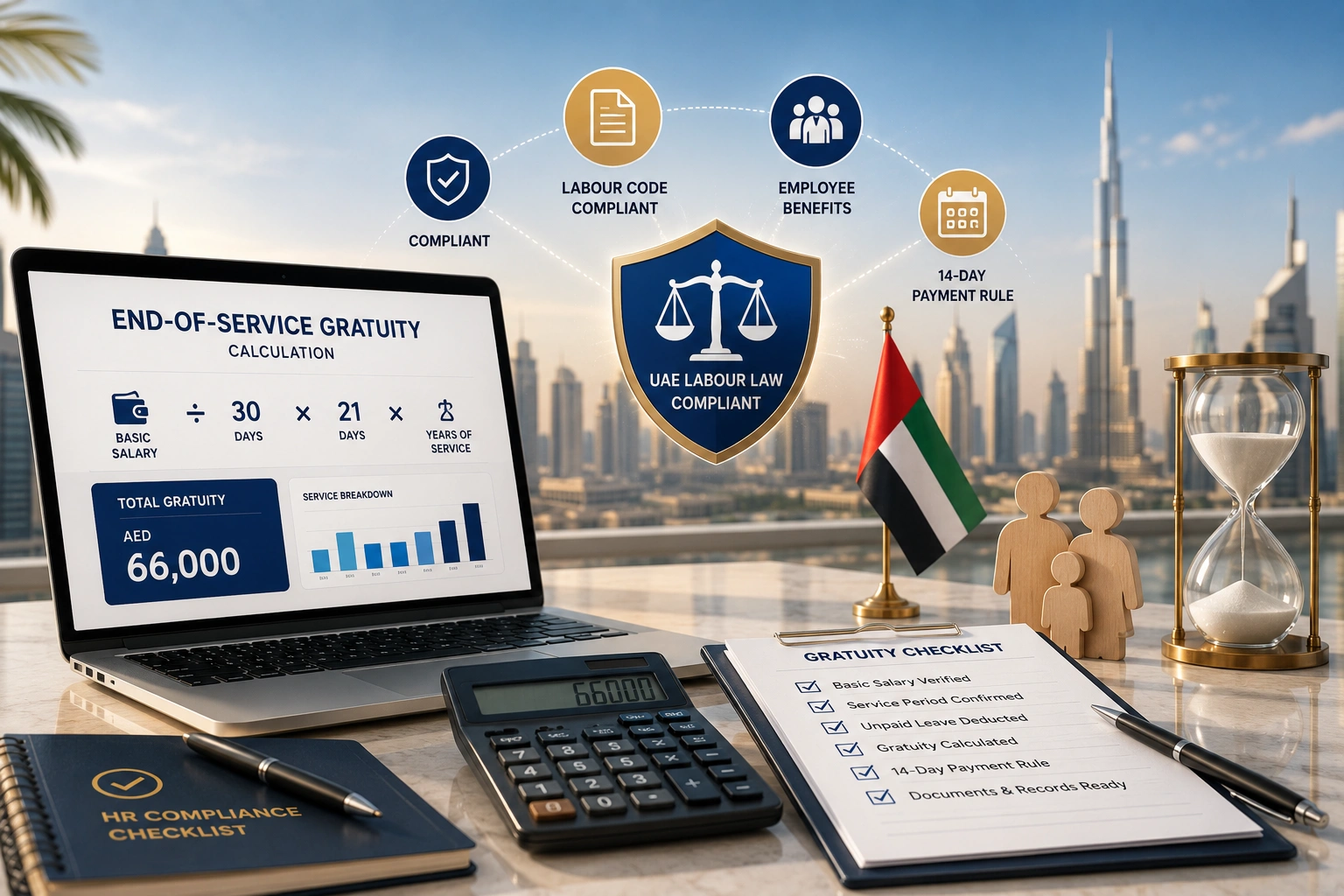
End-of-Service Gratuity (EOSB) is the mandatory lump-sum payment due to all eligible private-sector employees upon contract termination. Under Article 51 of Federal Decree-Law No. 33/2021, it is calculated at 21 days of basic salary per year for the first 5 years and 30 days per year beyond 5 years. Year-end EOSB reviews (December) and mid-year checks (July) are best practice to ensure accruals are accurate and provisions are correctly stated in company accounts.
Q5. What is the penalty for not meeting Emiratisation targets in 2026?
Penalties for Emiratisation non-compliance in 2026 reached AED 108,000 per unfilled Emirati position per year. For companies with 50 or more employees that failed to meet the June 30 H1 target, penalties began on July 1, 2026. MOHRE also has the authority to suspend new work permit applications for non-compliant companies. Separately, fictitious Emiratisation (fake hires) carries criminal fines of AED 20,000-100,000 per fictitious hire.