

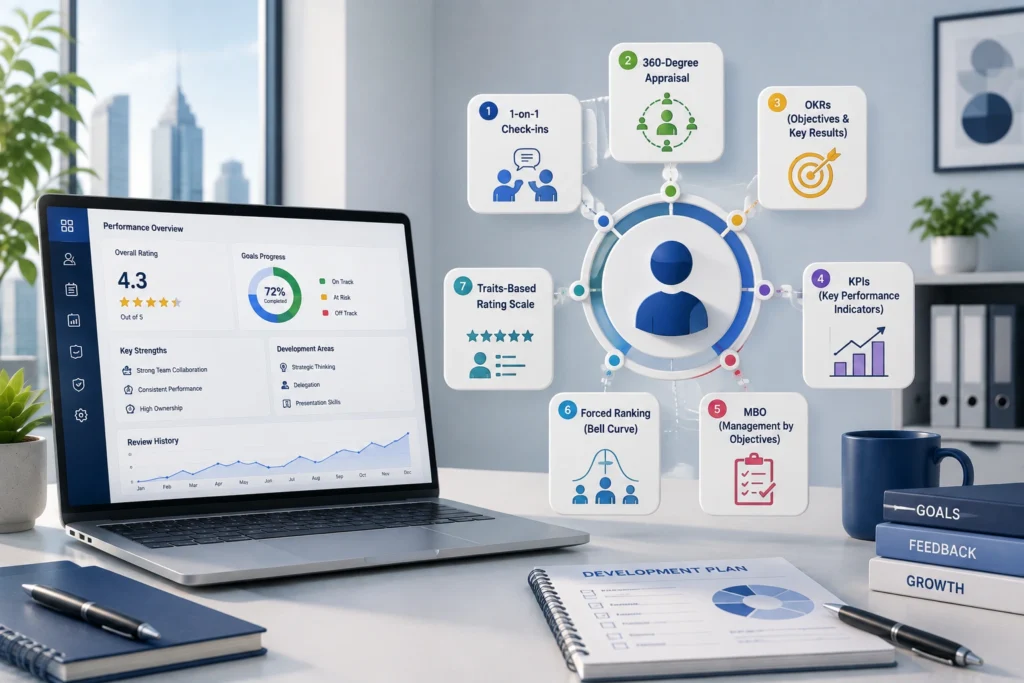
Performance appraisal methods are the structured approaches organisations use to evaluate how employees are performing against expectations – but the method that works for a 20-person startup is rarely the right one for a 2,000-person enterprise. This guide explains all 7 of the most widely used appraisal methods hr teams deploy, with an honest look at what each approach does well, where it fails, and which company types and roles it suits best.
TL;DR – AT A GLANCE
|
📌 Research: Only 14% of employees strongly agree their performance review inspires them to improve, per Gallup research. Source: Gallup – Fix the Problem with Performance Reviews
What Are Performance Appraisal Methods?
Performance appraisal methods are the frameworks that determine how a manager (or the organisation) evaluates employee performance: what data is gathered, from whom, on what cadence, and against what criteria. They are distinct from the appraisal system or platform (the software), which manages the process. A solid employee appraisal management platform can support any of the methods below – but the method itself is a strategy, not a tool.
Different performance appraisal types answer different questions: Am I meeting targets? How do my peers see me? Am I growing toward my goals? Am I behaving in line with company values? The best organisations combine 2-3 methods rather than relying on one.
Method 1: 1-on-1 Check-ins (Continuous Feedback)
Regular, structured conversations between a manager and employee – weekly, biweekly, or monthly – focused on progress, blockers, and development rather than formal scoring.
- Best for: all roles and company sizes; especially valuable for remote and distributed teams where informal feedback gaps are widest.
- Pros: lowest friction to implement; builds manager-employee trust; catches performance issues early; adaptable to any role type.
- Cons: quality depends almost entirely on the manager’s skill and consistency; no structured output or score makes aggregation across teams difficult.
1-on-1s work best as the backbone of a performance system – supplemented by a more structured method for formal review cycles.
Method 2: 360-Degree Appraisal
Feedback is gathered from multiple sources – direct manager, peers, direct reports, and sometimes external stakeholders or clients – and consolidated into a holistic performance view. HROPAL’s 360-degree appraisal system runs the full cycle: survey design, anonymised collection, and manager review in one workflow.
- Best for: leadership development, team-based roles, and any situation where a manager’s view alone is insufficient or potentially biased.
- Pros: surfaces blind spots a manager would miss; reduces single-rater bias; develops self-awareness, especially in senior roles.
- Cons: time-intensive for all participants; anonymous feedback can be weaponised without good facilitation; requires significant training to interpret well.
Method 3: OKRs (Objectives and Key Results)
Each employee sets 3-5 ambitious objectives for a quarter, each with 2-5 measurable key results that define what success looks like. OKRs cascade from company to team to individual, creating alignment. HROPAL’s task and goal-setting module manages OKR tracking across teams.
- Best for: tech companies, startups, and roles where output is project-based or strategic rather than volume-based. Quarterly cadence suits fast-moving environments.
- Pros: creates explicit alignment between individual work and company strategy; encourages ambitious goal-setting; transparent across the organisation.
- Cons: poorly implemented OKRs create administrative overhead without strategic value; not suited to roles with unpredictable or reactive output.
Method 4: KPIs (Key Performance Indicators)
Predefined metrics that measure performance against specific operational targets – quota attainment, response time, defect rate, customer satisfaction score. KPIs are set by the role, not collaboratively by the individual.
- Best for: sales, customer service, operations, and any role where output is clearly quantifiable. One of the most widely used appraisal methods hr teams in commercial roles rely on.
- Pros: objective, consistent, easy to compare across teams; removes subjectivity from measurement; ties directly to business outcomes.
- Cons: narrow focus can incentivise metric gaming at the expense of quality or collaboration; misses behavioural and developmental dimensions of performance.
📌 OKR vs KPI: okr vs kpi is one of the most-searched HR questions. The distinction is simple: OKRs set aspirational direction (where are we going?); KPIs measure ongoing operational performance (how are we doing right now?). Most organisations need both, applied to different questions.
Method 5: MBO (Management by Objectives)
The manager and employee jointly define individual objectives linked to organisational goals at the start of a review cycle. Performance is assessed at the end against those agreed targets.
- Best for: professional and managerial roles, mid-market companies, and organisations running annual review cycles. Works well where roles have significant planning and project components.
- Pros: increases employee ownership by making goal-setting collaborative; links individual work to business strategy; gives managers a structured framework for feedback conversations.
- Cons: annual cycles are too slow for fast-moving environments; objectives can become stale by mid-year; can degenerate into a box-ticking exercise if managers aren’t skilled at objective-setting.
Method 6: Forced Ranking (Bell Curve / Forced Distribution)
Employees are ranked relative to peers and distributed across predefined performance tiers – typically top performers (10-20%), core performers (70-80%), and underperformers (10%). Made famous by GE’s ‘vitality curve’ in the 1980s.
- Best for: large organisations with competitive, results-driven cultures – particularly in sales. Rarely appropriate for small teams or collaborative environments.
- Pros: forces managers to make meaningful distinctions rather than rating everyone in the middle; creates clear visibility of high performers and persistent underperformers.
- Cons: damages team collaboration and psychological safety; statistically meaningless for teams under 20 people; disproportionately high attrition risk; increasingly rejected by modern HR practice.
Method 7: Traits-Based / Behavioural Rating Scale
Employees are rated on a standardised list of traits or competencies – communication, initiative, reliability, teamwork – using a fixed scale (e.g. 1-5 or outstanding/good/needs improvement).
- Best for: large organisations with standardised roles, compliance-heavy industries (banking, healthcare, government), and settings where consistency of assessment across thousands of employees matters more than individual nuance.
- Pros: simple to administer and understand; consistent framework across the organisation; useful for compliance documentation.
- Cons: highly subjective; prone to halo effect, recency bias, and manager leniency bias; provides limited developmental value beyond the rating itself.
Which Performance Appraisal Method Fits Your Company? A Comparison Table
Use this as a starting point – most organisations benefit from combining 2 of these performance appraisal types rather than applying one universally. HROPAL’s employee performance management platform supports all seven, configurable by role, team, and review cycle.
| Method | Best role type | Company size | Main risk | Cadence |
|---|---|---|---|---|
| 1-on-1 check-ins | All roles | Any | Manager skill dependency | Weekly / monthly |
| 360-degree appraisal | Leadership, team roles | Mid-to-large | Time investment | Biannual / annual |
| OKRs | Strategic / outcome roles | Startup to enterprise | Over-engineering goals | Quarterly |
| KPIs | Sales, ops, service | Any | Metric gaming | Monthly / quarterly |
| MBO | Professional / managerial | Mid-market | Annual cycle too slow | Annual |
| Forced ranking | Large sales orgs | Large only (20+) | Collaboration breakdown | Annual |
| Traits-based rating | Standardised / compliance roles | Any | Subjectivity and bias | Annual |
Five Common Mistakes When Choosing or Implementing Appraisal Methods
- One method for all roles. Sales teams and engineers don’t respond to the same approach. Segment by role type before choosing a method, not after.
- Annual-only cadence. Annual reviews capture a snapshot of 12 months through the lens of the most recent 3. Add quarterly check-ins or OKR reviews to keep feedback timely. See HROPAL’s related guide on annual performance appraisal driving employee growth for getting the annual cycle right.
- No manager training. 360-degree appraisals and MBO both fail without managers who can facilitate feedback and set meaningful objectives. Tool access is not the same as capability.
- Confusing OKRs and KPIs. okr vs kpi confusion leads organisations to track aspirational goals as operational metrics or vice versa. OKRs set direction; KPIs measure current performance. Both have a place, but in different conversations.
- Forced ranking in small teams. Distributing a team of 8 into performance tiers is statistically meaningless and organisationally damaging. Reserve forced ranking for large cohorts only, if at all.
📌 Further reading: SHRM’s performance management resources cover design, legal considerations, and manager enablement for each appraisal approach. Source: SHRM – Performance Management (shrm.org)
Frequently Asked Questions
Q1. What are performance appraisal methods?
Performance appraisal methods are structured frameworks used to evaluate employee performance – defining what is measured, who provides input, how frequently, and against what criteria. Common performance appraisal types include 1-on-1 check-ins, 360-degree appraisals, OKRs, KPIs, Management by Objectives, forced ranking, and traits-based rating scales.
Q2. What is the most effective performance appraisal method?
There is no single most effective method – the right approach depends on role type, company size, and review cadence. Most modern HR teams combine continuous 1-on-1 check-ins (for ongoing feedback) with OKRs or KPIs (for goal-tracking) and a 360-degree appraisal for leadership roles at annual review time.
Q3. What is the difference between a 360-degree appraisal and a standard performance review?
A standard performance review typically involves one evaluator (the direct manager). A 360 degree appraisal gathers input from multiple sources – peers, direct reports, and sometimes clients – giving a more comprehensive and less biased view of the employee’s performance, particularly on behavioural and collaboration dimensions.
Q4. What is the difference between OKRs and KPIs?
OKRs (Objectives and Key Results) are aspirational goal-setting tools – they define where a team or individual is trying to go. KPIs (Key Performance Indicators) are operational metrics that measure ongoing performance against predefined targets. The okr vs kpi distinction matters because they serve different conversations: OKRs in strategic planning, KPIs in operational reviews.
Q5. What are the main types of performance appraisal?
The main performance appraisal types are: 1-on-1 continuous feedback, 360-degree appraisal (multi-rater), OKRs, KPI-based assessment, Management by Objectives (MBO), forced ranking (bell curve), and traits-based or behavioural rating scales. Most organisations use a combination of two or three rather than a single method.
Q6. What are the most common mistakes in performance appraisal?
The most common mistakes are: applying one method to all roles regardless of type, using an annual-only cadence that makes feedback stale, not training managers to facilitate appraisals effectively, confusing OKRs with KPIs, and using forced ranking in teams too small to make it statistically meaningful.